
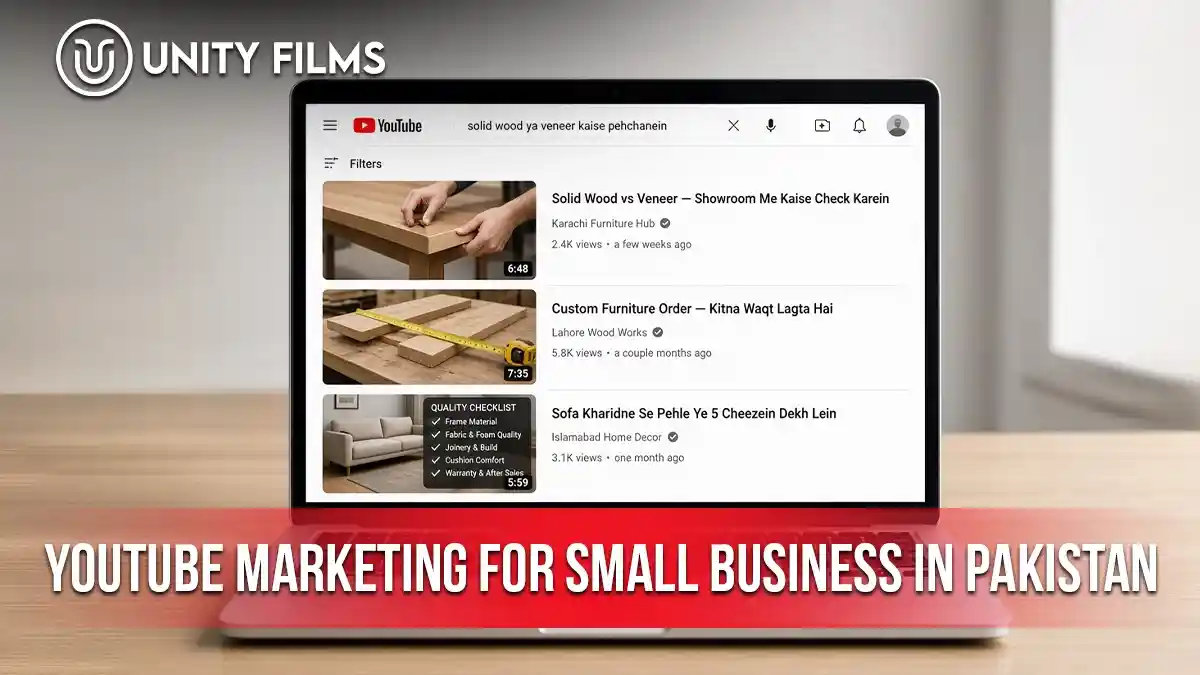
Quick answer: YouTube marketing for small business in Pakistan works when your customers research before buying and your conversion point is WhatsApp, not a website form. Expect 3 to 6 months before enquiries arrive steadily. It does not suit every business, and for many local shops a free Google listing produces customers faster and cheaper.
Every agency page you will find on this topic says the same three things. YouTube is huge. Video is the future. Contact us for a data-driven strategy.
None of them answer the question you are actually asking, which is whether this will bring you customers, how much of your time it will eat, and who is going to make the videos.
This guide is written for a business owner, not a content creator. There is nothing here about the algorithm, watch hours, or monetization, because none of that pays your bills. Your channel does not need to earn ad revenue. It needs to make your phone ring.
What Does YouTube Marketing for a Small Business Actually Involve?
Four things, and only one of them is filming.
Before any of it, check that the audience is actually there for your category. Pakistan’s overall reach figures are published each year in DataReportal’s Digital 2026 Pakistan report, and they are worth a look, but national totals tell you nothing about whether people search for what you sell. That part you check yourself.
Working out what your customers search before they buy. Not what you want to say about your business. What they type when they are still deciding. A dental clinic’s real audience is searching what a procedure feels like and what goes wrong, not the clinic’s name.
Making videos that answer those questions. Usually shorter than people expect. A clear four-minute answer beats a polished fifteen-minute brand film for this purpose.
Packaging so people click. Title, thumbnail, description, and the channel settings underneath. This is where most business channels quietly fail. Good video, invisible packaging, nobody watches. The same search logic that governs a web page governs a video, and Backlinko’s local SEO guide covers the underlying principles if you want the longer version.
Routing viewers to WhatsApp. Covered in its own section below, because in Pakistan it is the difference between a channel that produces enquiries and one that produces compliments.
Notice what is not on that list. Subscriber counts, monetisation, and view targets. You can ignore YouTube’s Partner Programme requirements entirely. A business channel with 800 subscribers that produces fifteen WhatsApp enquiries a month is working. A channel with 40,000 subscribers and no enquiries is a hobby.
When YouTube Is Not the Right Channel for Your Business
Most agency pages tell you every business needs this. That is not true, and you already know it.
If you run a local shop, salon, or clinic and your Google listing is half-finished, fix that first. The Maps 3-pack sits above everything on a phone, costs nothing, and produces calls in weeks rather than months. Our guide on GMB optimization covers it, and how to add business on Google Maps covers setup. Spending on video while that sits empty is paying for something you could have had free.
If you need customers this month, YouTube will not save you. YouTube marketing for small business in Pakistan is a compounding channel. Ads are the fast one.
If nobody in your business will commit an hour a week, do not start. Not filming time, decision time. Approving topics, checking scripts, answering the questions that come in. A channel that goes quiet after six videos is worse than no channel, because it makes the business look abandoned.
If your product needs no research before purchase, the fit is weak. Nobody watches a video before buying a bottle of cooking oil. They do watch before choosing a dentist, a lawyer, a school, a contractor, or a fifty-thousand-rupee sofa.
If you cannot answer WhatsApp within an hour, the enquiries will arrive and go to whoever replied first. Fix the response habit before you build the thing that generates enquiries.
None of that means never. It means not yet, and usually in that order.
Do You Have to Be on Camera?
This is the question every business owner asks second and nobody addresses first.
No, but something has to replace you. The options, roughly in order of how well they work in Pakistan:
You on camera. Strongest by a distance for service businesses. People hire the dentist, the lawyer, the architect. Seeing a face builds the trust that closes the enquiry. Most owners hate the first two videos and are fine by the fifth.
A staff member on camera. Works well when they actually know the work. A senior technician explaining a repair is more convincing than the owner reading a script.
The work itself, with voiceover. No face at all. The build, the procedure, the installation, the before and after. This suits workshops, salons, construction, and manufacturing very well.
Screen or product only. Fine for software, courses, and anything demonstrated rather than performed.
Ye sawaal jitna bara lagta hai utna hai nahi. Aap ko presenter banne ki zaroorat nahi, sirf apne kaam ke baare mein saaf baat karni hai.
How Long Before You See Enquiries?
Real numbers, because the honest timeline is a competitive advantage when everyone else writes “measurable results.”
| Channel | First meaningful result |
|---|---|
| Paid ads | First week |
| Google Business Profile | 4 to 8 weeks |
| YouTube and SEO | 3 to 6 months |
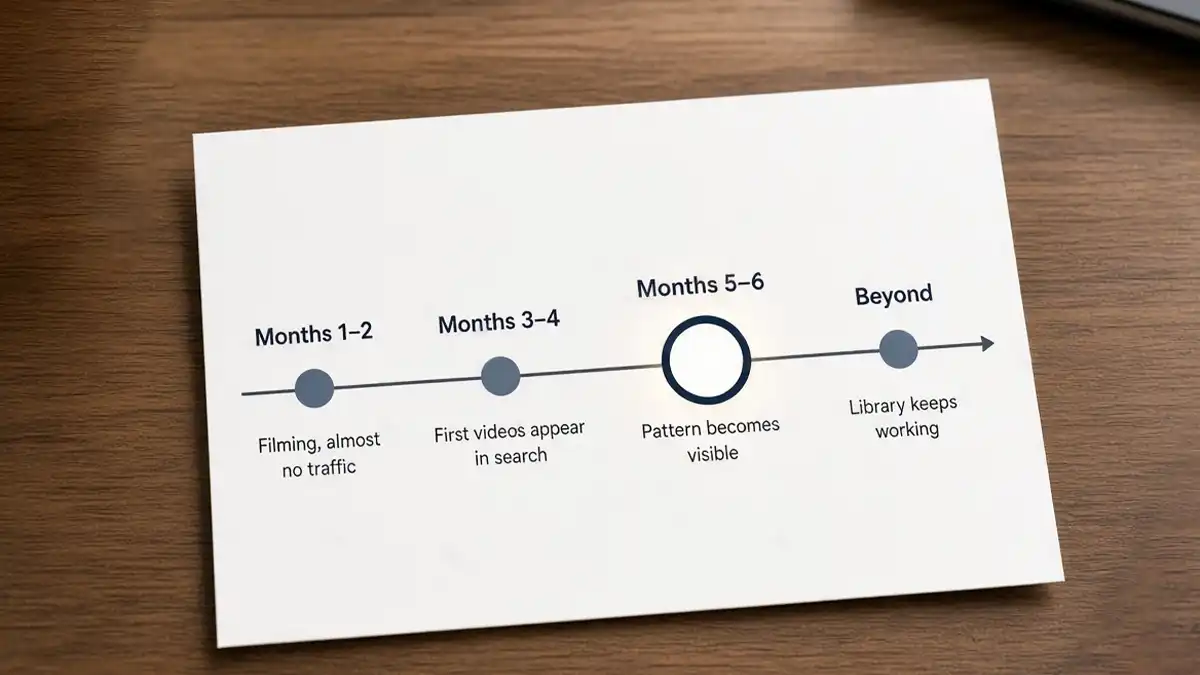
For YouTube specifically, here is the shape of it.
Months 1 to 2. Filming, publishing, almost no traffic. This is the part that kills most business channels. Nothing appears to be happening because nothing is, yet.
Months 3 to 4. Individual videos start appearing in search. The first enquiries arrive, usually from an unexpected video rather than the one you were proud of.
Months 5 to 6. A pattern becomes visible. You can see which topics produce enquiries and which produce views, and those are rarely the same topics.
Beyond. The library keeps working. A video published in month two continues producing enquiries in month twenty, which is the entire reason to do this rather than only running ads.
If anyone promises enquiries in week three, they are selling ads and calling it YouTube marketing.
Why Your Conversion Point Is WhatsApp, Not Your Website
This is the single biggest structural difference between YouTube marketing for small business in Pakistan and the same advice written for the US or UK.
A Pakistani viewer who wants to buy does not fill in a form. They message. If the path from your video to a WhatsApp conversation has more than one step, you lose most of them.
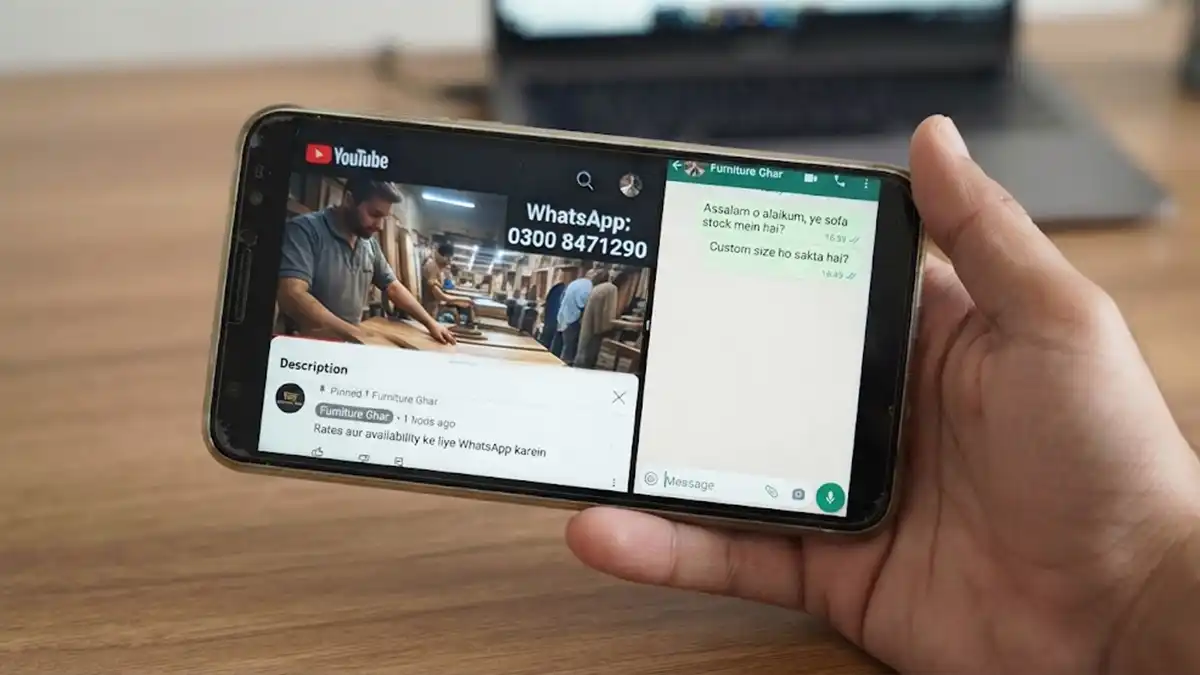
Practical version:
Put the number in the video itself, spoken and on screen. Descriptions get read by a minority.
Use a WhatsApp link, not a phone number, so one tap opens a chat rather than a dialler.
Pin a comment with the same link on every video.
Test the whole path on a mid-range Android on mobile data. Not on your laptop, not on the newest iPhone in the office. That is the device almost every viewer will be holding, and a link that works on your desktop often does not open cleanly on a three-year-old phone.
Reply in the language they message in. If someone writes in Urdu or Roman Urdu, reply the same way. Many owners believe English looks more professional. For a local customer it usually reads as distance.
Who Actually Makes the Videos?
Worth asking any agency you speak to, because the answer is often uncomfortable.
Most digital agencies in Rawalpindi and Islamabad sell SEO, web, and social media. When a client asks for video, the work goes to a freelancer, and the agency becomes a middleman between you and someone you never meet. That is why so many agency showreels look nothing like the work they deliver.
Here is what an in-house process looks like instead, so you know what to compare against.
Topic selection before anything else. Search demand drives the list, not what the business feels like talking about.
Scripting. Short, spoken, no jargon. Written to be said out loud by a real person rather than read from a teleprompter.
A shoot day. One day on site produces four to six videos. The crew brings the camera, lights, and audio. Filming happens at your premises during your working hours, because reshoots are what make video expensive.
Editing, thumbnails, and packaging in the same house. The person cutting the video has seen the shoot. The person making the thumbnail has seen the edit. Nothing gets explained twice across three freelancers.
Publishing and measurement. Not just uploading. Tracking which videos produce WhatsApp conversations, then making more of those.
This matters more in YouTube marketing for small business in Pakistan than in bigger markets, because budgets are tighter and a wasted shoot day is money you do not get back. Ask for the process. An agency that shoots will describe a shoot day without hesitating. One that subcontracts will talk about strategy instead.
Worked Example: Why Two Videos a Month Beats Twenty
This is arithmetic with stated assumptions, not a client case study.
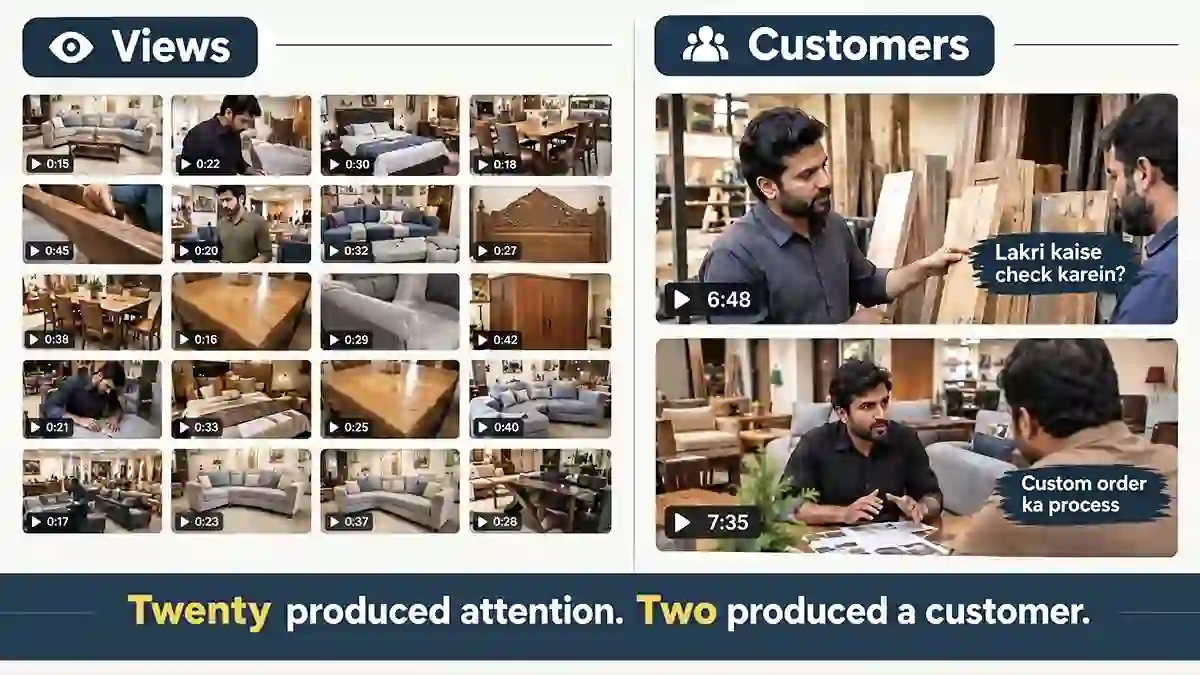
Take a furniture showroom. Option one is twenty short clips a month, filmed on a phone, mostly product shots with music. Option two is two proper videos a month answering questions buyers actually ask: how to tell solid wood from veneer, and what a custom order really costs you in waiting time.
The twenty clips collect views from people scrolling. Almost none of them are shopping today.
The two videos collect a smaller number of views from people typing those exact questions into search, which means every single viewer is already considering a purchase. Those videos keep appearing in search results for years, while a clip is invisible after a week.
Now the part that decides it. One of those two videos sits in front of someone comparing three showrooms. It is the only one that answers the question honestly, including the parts that are inconvenient. That viewer messages on WhatsApp already trusting the business.
Twenty pieces of content produced attention. Two produced a customer.
For a small business with limited time, this is the whole argument. You are not competing for views. You are competing to be the business that answered the question.
What Does It Cost?
We do not publish rates, because the honest answer is that it depends on things we would need to ask you about first. What it depends on:
How many videos per month. The biggest single factor.
Whether shooting is included or you supply footage. Editing-only work costs far less than a crew arriving at your premises.
Whether it is one location or several. A single shoot day covering several videos is efficient. Scattered filming is not.
How many revision rounds you want.
Who does the work. A senior editor and a junior editor do not cost the same and do not produce the same result.
Anyone quoting a figure before asking those questions is either guessing or selling a package that does not fit your business.
FAQs
Is YouTube worth it for a small local business in Pakistan?
It depends on whether your customers research before buying. For dentists, lawyers, schools, contractors, showrooms, and clinics, yes, because people compare before committing. For low-value everyday purchases, usually not. Start with your free Google listing instead.
How many videos do I need before anything happens?
Think in months rather than counts. A realistic starting point is two useful videos a month for six months. Twelve videos that answer real questions will outperform sixty clips made to fill a schedule.
Can I just run YouTube ads instead of building a channel?
You can, and ads work faster. The difference is that ads stop the day you stop paying, while a video that ranks keeps producing enquiries. Most businesses end up doing both, with ads covering the first few months while the channel is built.
My competitors are not on YouTube. Does that mean it does not work?
More often it means nobody has done it yet in your category. In most Pakistani verticals the search results for buying questions are thin, which is an opening rather than a warning. Check what people search in your category before deciding either way.
Working With Unity Films
We do the shooting ourselves. Our team scripts, films, edits, makes thumbnails, and publishes, and the same people stay on your channel month to month. Our video marketing work is built around that.
We will also tell you when video is the wrong spend this quarter. For a local business with an empty Google listing, we will usually say fix that first, even though it is not the bigger project.
If you want to know whether your category has search demand worth filming for, send us your website and your city. We will look at what people are actually searching before they buy what you sell.
Final Thoughts
YouTube marketing for small business in Pakistan is not about becoming a creator. It is about being the business that already answered the question when a customer goes looking.
Two things decide whether it works. Whether your customers research before they buy, and whether someone will commit to it for six months rather than six weeks.
If both are true, the library you build keeps working long after you stop paying for attention. If either is false, spend the money somewhere faster and come back to this later.