
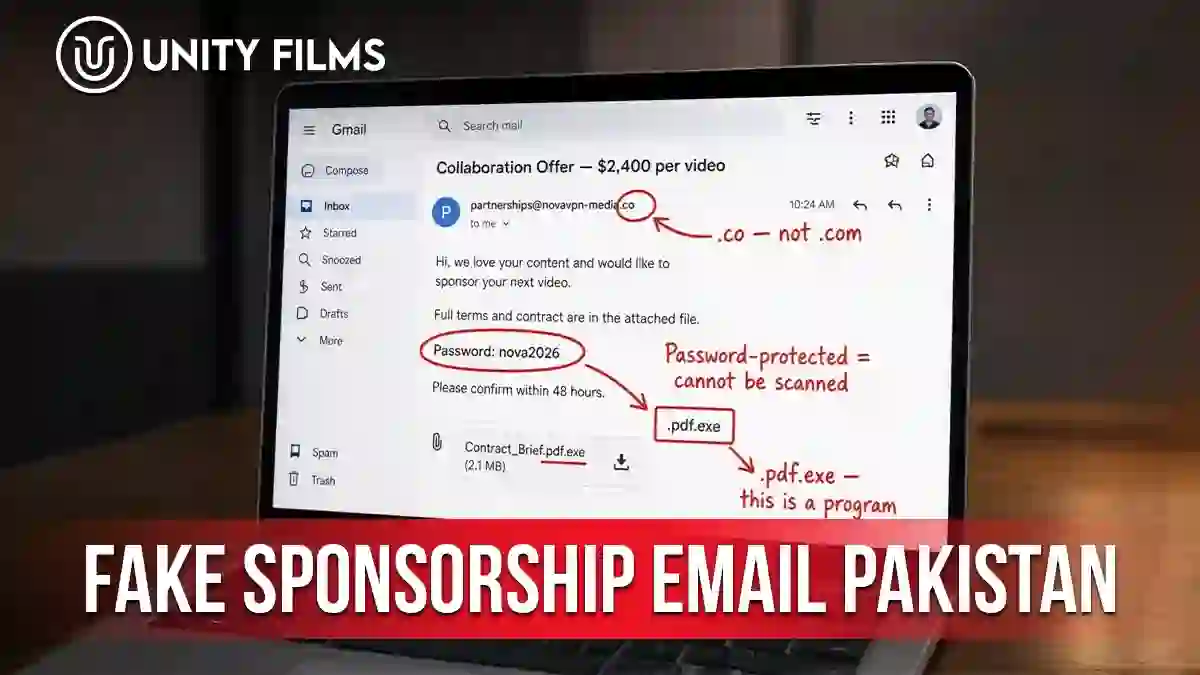
Quick answer: The fake sponsorship email Pakistan creators receive offers a brand deal and asks you to download a brief or contract. That file copies your browser session cookie, letting an attacker into your account without your password and without your two-factor code. No real brand makes you download a file to see the terms.
A brand deal lands in your inbox. Good money, a product you would actually use, and a contract attached.
This is the one email every creator is hoping to receive, which is exactly why it is the one attackers send.
Your channel is not stolen by someone guessing your password. It is handed over the moment you open the attachment, and by the time you notice, the channel has been renamed and is live-streaming a crypto giveaway to your own subscribers.
This guide explains how it works, why the protection you think you have does not stop it, and what to do if you have already clicked.
How the Fake Sponsorship Email Actually Works
The fake sponsorship email Pakistan creators see is the easy part to fake. The dangerous part is the file.
The approach. A friendly message from a brand, often one you recognise, offering a collaboration. Sometimes a VPN, an antivirus, a game, an editing app, or a local e-commerce platform. It reads professionally and references your content.
The hook. You must download something to see the details. A brief, a contract, a media kit, or a piece of software you are asked to review. It might be a .zip file, something ending in .exe or .scr dressed up to look like a PDF, or a Google Drive file with a password included in the email.
That password is not a courtesy. Password-protected archives cannot be scanned by email security, which is exactly why they use them.
The payload. Opening it installs an information stealer. The malware does not need your password. It copies the session cookie your browser uses to keep you logged into Google.
The takeover. The attacker loads that cookie into their own browser and your account opens for them as though they had typed everything correctly. Channel renamed, your videos hidden or deleted, and a fake crypto giveaway broadcasting to the audience you spent years building.
This is not a rare or exotic attack. Security researchers tracking one campaign counted more than 200,000 creators targeted across hundreds of mail servers. Linus Tech Tips, a channel with a large professional team, lost three channels this way after one employee opened a sponsorship brief.
Why Does Two-Factor Authentication Not Protect You?
This is the part that catches experienced creators, and it is worth understanding properly.
Two-factor authentication protects the moment you log in. You enter a password, then a code, and the session begins.
Cookie theft skips that moment entirely. The session cookie is proof that someone already passed the check. The attacker is not logging in, they are reusing a login that already happened.
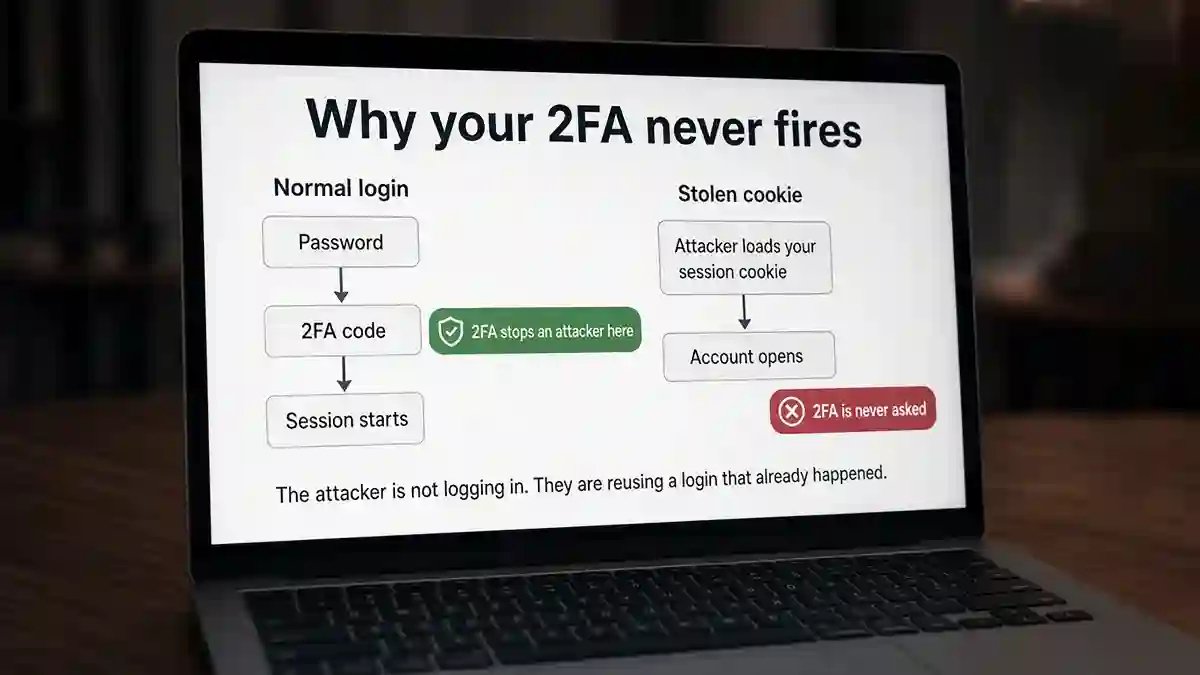
So your 2FA never fires. There is no prompt on your phone, no code to approve, and no notification to ignore. The first sign is usually that you cannot get into your own account.
This is why “I have 2FA enabled” is not an answer to this threat. It is necessary and it stops other attacks. It does not stop this one.
What Are the Red Flags?
A fake sponsorship email Pakistan creators receive usually shows two or three of these. Real offers show none.
| Red flag | What a real brand does instead |
|---|---|
| You must download a file before seeing terms | Terms are in the email body or a clearly named PDF |
| Password-protected .zip or Drive file | No password, nothing to unlock |
| File ending in .exe, .scr, or .pdf.exe | An actual PDF |
| “Click here to confirm and unlock your contract” | A normal email conversation |
| Deadline pressure, respond in 48 hours or lose it | Brands move slowly and expect questions |
| An offer far above what your channel is worth | An offer roughly in line with your views |
| You are asked to pay anything upfront | Brands pay you, never the reverse |
| Sender domain is slightly wrong | The brand’s real domain, spelled correctly |
That sixth row is worth dwelling on. If you do not know what your channel is actually worth, you cannot recognise an offer that is absurdly high. Our guide on YouTube sponsorship rates in Pakistan covers how to work out your own figure from your median views. Knowing your rate is a security control as much as a business one.
Check the sender address character by character. A single swapped letter, an extra hyphen, or a .co instead of a .com is the whole trick.
How Do You Verify an Offer Without Risking Anything?
Four steps, and none of them take long.
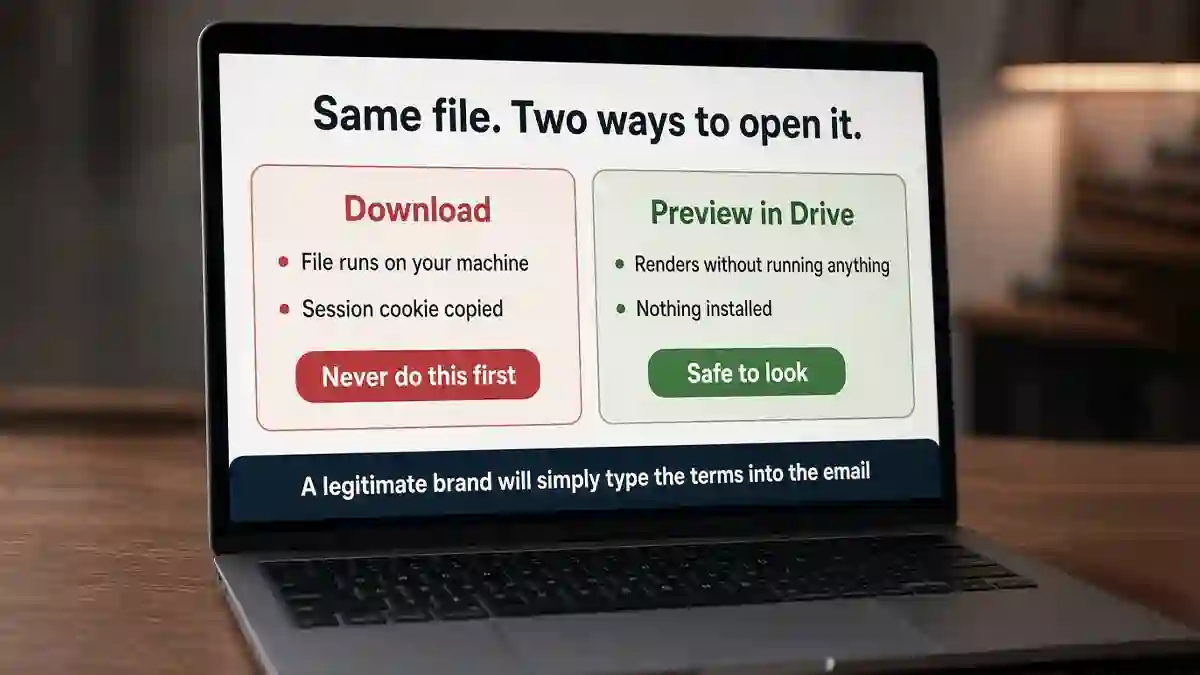
Never open the attachment first. If you must look at a document, open it in Google Drive’s preview instead of downloading it. Preview renders it without running anything on your machine.
Find the brand yourself. Do not reply to the email or use a phone number inside it. Go to the company’s official website, find their marketing or partnerships contact, and ask whether the offer is genuine. Two minutes, and it settles the question completely.
Check the person exists. Search the name and the company together. A real partnerships manager has some footprint somewhere.
Ask for the terms in the email body. A legitimate brand will simply type the offer out. One that insists you must open the file to see anything has told you what it is.
If it turns out to be genuine, none of this offends anybody. Brands deal with cautious creators every day.
What If You Already Clicked?
Act in this order, because the order matters more than the speed.
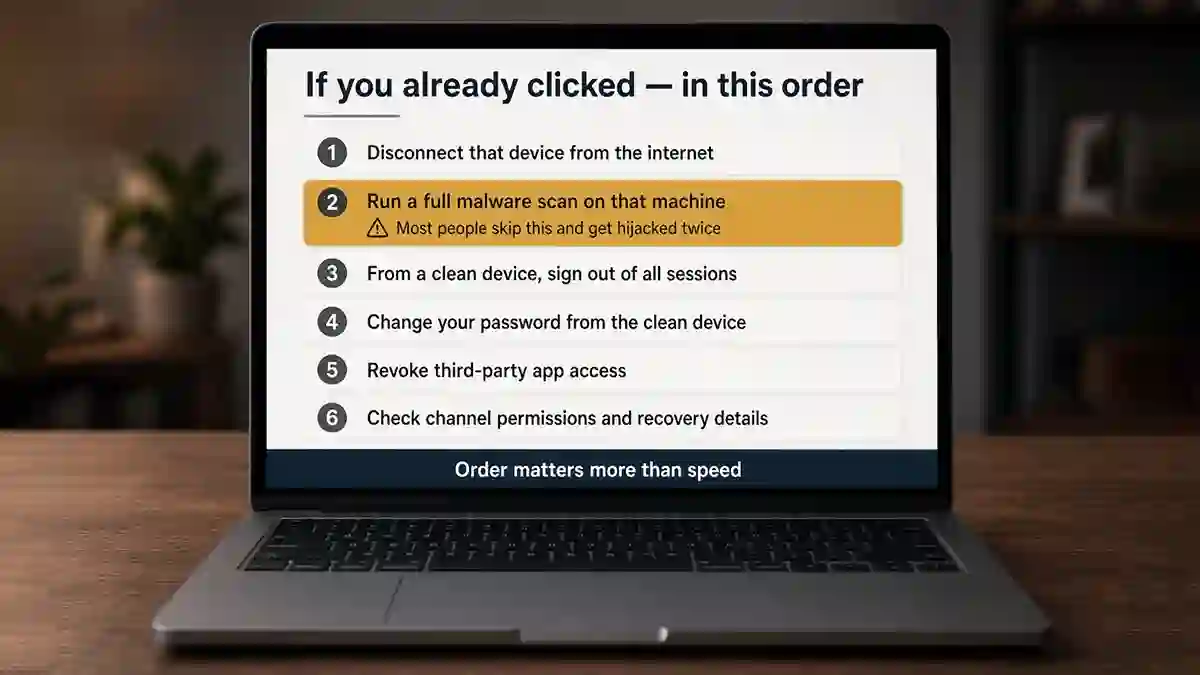
1. Disconnect that device from the internet. Stop further data leaving.
2. Run a full malware scan on that machine. Do this before you reset anything. If the stealer is still running, a new password set on that computer is simply exfiltrated again. This is the step almost everyone gets wrong.
3. From a different, clean device, sign out of all sessions. In your Google account security settings, sign out everywhere. This invalidates the stolen cookie.
4. Change your password from the clean device. Not the infected one.
5. Revoke third-party app access. Malware sometimes leaves OAuth grants behind, and those can survive a password reset. Remove anything you do not recognise.
6. Check your channel permissions and recovery details. Attackers add themselves as managers and change recovery emails and phone numbers. Review all of it through your YouTube settings and the Brand Account permissions page.
7. If you have lost access, use the official recovery form. Google’s hijacked channel recovery is the correct route. Google has stated that YouTube detects and auto-recovers the large majority of hijacked channels, so do not give up because the first hours look bad.
8. Warn your audience. A post or a Short saying your channel was compromised protects the people who trust you, some of whom will otherwise send money to a fake giveaway with your name on it.
How Do You Make Your Channel Hard to Take Over?
Prevention against a fake sponsorship email Pakistan attackers send is mostly structural rather than technical.
Use a separate email for business enquiries. The address on your channel’s About page is how attackers find you. It should not be the address you log into YouTube with. This single change removes most of your exposure.
Never share passwords with editors or an agency. Move the channel to a Brand Account and add people through channel permissions as manager or editor instead. You keep ownership, access can be removed in seconds, and nobody needs your login. Kisi ko bhi apna password dene ki zaroorat nahi hoti, chahe wo aap ka apna editor ho.
Turn on Google Advanced Protection if your channel is a meaningful part of your income. It is stricter than standard 2FA and specifically resistant to this class of attack.
Do not open work files on a machine with pirated software on it. Cracked software and info-stealers arrive through the same doors, and a machine already carrying one is a poor place to open anything from a stranger.
Keep a separate browser profile for channel work, so the session cookie that matters is not sitting in the same place as your general browsing.
Back up your videos. If the worst happens, rebuilding is far easier when the footage still exists somewhere.
FAQs
A brand emailed me from a Gmail address. Is that automatically fake?
Not automatically, since small brands and some agencies do use free email. Treat it as a reason to verify rather than a verdict. The download demand is the real signal, not the domain.
Can I just scan the attachment with antivirus before opening it?
It helps and it is not enough. Fresh info-stealer builds routinely get past scanners for a while, and password-protected archives cannot be scanned at all. Preview in Drive or verify with the brand instead.
They are offering more money than I expected. Is that a red flag on its own?
Often, yes. An offer far above what a channel your size normally commands is one of the most reliable signals in this whole list. Work out your realistic rate so that you can recognise an unrealistic one.
My channel was hijacked and later recovered. Am I safe now?
Only after you clean the device that was infected and revoke any lingering app access. Recovering the channel does not remove the malware, and several creators have been hijacked a second time from the same machine.
Working With Unity Films
We manage YouTube channels for creators and businesses across Pakistan, which means we are given access to channels regularly. We ask for manager or editor permissions through the Brand Account, never a password, and any agency that asks you for your Google login is telling you how they operate.
Our YouTube channel management work covers the growth side, and our guide on Google AdSense Pakistan covers the payment setup that attackers are often ultimately after.
If you have received something that does not feel right, send it to us before you open it.
Final Thoughts
The fake sponsorship email Pakistan creators fall for works because it arrives as good news. Nobody inspects an offer they were hoping for as carefully as one they were dreading.
One rule covers almost every version of this attack. No real brand requires you to download a file before you can read the terms. If a file stands between you and the details, the file is the point.
And keep your business email separate from your login. It is the least interesting security advice on this page and it is the one that would have saved most of the channels lost this way.