
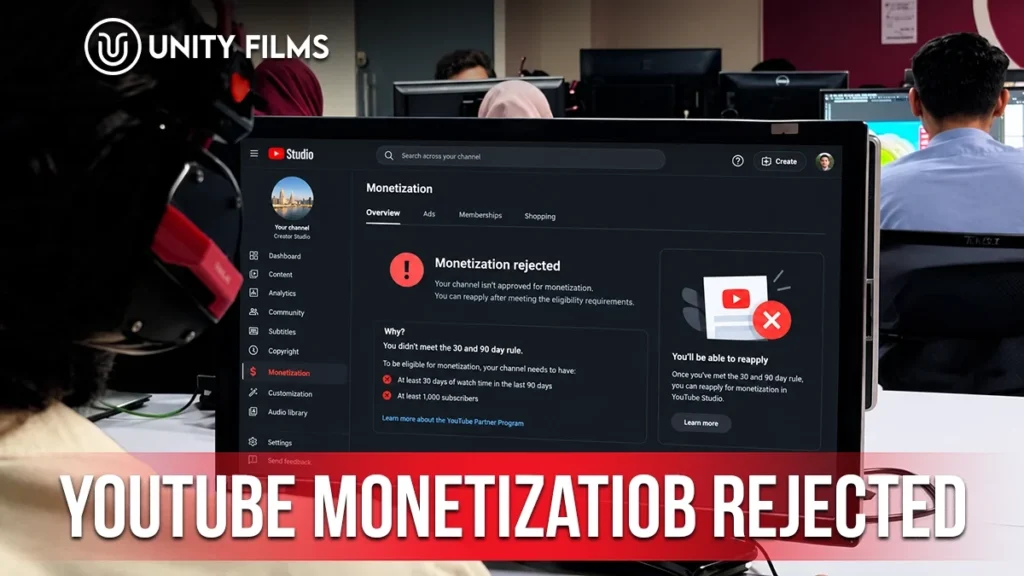
Quick answer: YouTube monetization rejected means human reviewers judged a significant part of your channel to be outside policy. You have 21 days to appeal if you believe it was wrong, 30 days before a first reapplication, and 90 days before any later one. The rejection email names the exact policy, and that is the only thing worth acting on.
You hit the subscriber and watch hour targets, applied, waited, and the email says your channel was not approved.
Most creators do one of two things next. They reapply immediately, which does nothing because the waiting period has not passed. Or they change thumbnails and titles at random, which does nothing because that was not the problem.
The rejection email contains the answer. It names the policy your channel was judged against. Everything useful starts there.
If you are still working towards the thresholds rather than past them, our guide to YouTube monetization requirements in Pakistan covers what the bar actually is and the February 2027 change coming to it.
What Does YouTube Monetization Rejected Actually Mean?
It means a person looked at your channel, not an algorithm.
YouTube’s page on why you were rejected for monetisation states that rejection means human reviewers believe a significant portion of your channel does not meet its policies and guidelines. Two words there matter.
Human. You are not fighting an automated system that mistook one video. Someone reviewed the channel as a whole.
Significant portion. This is a channel-level judgement, not a single-video one. Deleting one video rarely changes the outcome, because the reviewer was assessing the overall impression of the channel.
YouTube also says the specific policies your channel violated are named in the rejection email. That email is the only document that tells you what to fix, which is why reading it slowly beats any general checklist, including this one.
Appeal, or Wait and Reapply?
These are two different routes with different clocks, and picking the wrong one costs months.
| Appeal | Reapply | |
|---|---|---|
| Use it when | You believe the decision was wrong | The decision was fair and you have fixed things |
| Window | Within 21 days of the rejection email | 30 days after a first rejection; 90 days after any later one |
| What you are saying | You reviewed it incorrectly | The channel has changed since you looked |
| Applies how often | Available regardless of how many times you have applied | Each attempt resets the clock |
So the decision rule is simple. If you genuinely believe reviewers misread your channel, appeal inside 21 days, because that window closes and does not reopen. If the rejection was fair, do not waste the appeal; spend the 30 days fixing the named policy and then reapply.
The 90-day rule is the one that catches people. After your first rejection the wait is 30 days, but after any later rejection, or if you have already reapplied once, it becomes 90. Reapplying carelessly turns a one-month delay into a three-month one.
What Should You Fix Between Applications?
YouTube’s own suggested sequence is short and worth following in order.
- Read the rejection email and find the named policies. Nothing else should begin before this.
- Review your videos, titles, descriptions, thumbnails and tags against the channel monetization policies and Community Guidelines. Thumbnails and descriptions are assessed too, which surprises people who only review the videos.
- Edit or delete anything that violates those policies. Deleting is not automatically right; an edited description or a replaced thumbnail often fixes it.
- Check the whole channel again before reapplying, not just the videos you changed.
YouTube adds a line worth repeating: fixing these issues does not guarantee approval. Treat the 30 days as a genuine rebuild of the weakest part of the channel rather than a waiting room.
Reused content is the reason most commonly named in rejection emails, and it is the least understood. It does not simply mean you used footage you did not film. It means the channel does not add enough of your own commentary, editing or educational value on top of material that came from elsewhere. Compilations, clips with music over them, reaction videos where the reaction is minimal, and text-to-speech narration over stock footage all cluster here.
The fix is not removing the source material. It is making the channel’s own contribution obvious: original narration written by you, real editing choices, structure, your own face or voice, something that would not exist if you had not made it.
If you are rebuilding the channel around this, our post on how to write a YouTube script covers the part that does the most work, and best faceless YouTube niches for 2026 covers formats that stay original without putting you on camera.
Does Rejection Affect the Channel Itself?
No. Having YouTube monetization rejected sounds worse than it is, and the email reads worse still.
A rejection is not a strike. Your videos stay up, your subscribers stay, your analytics are unaffected, and you can keep uploading throughout the waiting period. What you do not have is ad revenue.
That matters because the waiting period is time you can use. A channel that keeps publishing through the 30 days arrives at the reapplication with more evidence of original work than one that went quiet waiting for permission.
It is also worth separating this from the two situations it gets confused with. Losing monetisation after having it is demonetisation, which is a different process. Ads being restricted rather than removed is the yellow icon, covered in YouTube limited ads.
When You Should Stop Reapplying
Two situations where having YouTube monetization rejected again is the predictable outcome, and the channel needs rebuilding rather than resubmitting.
You have been rejected twice for the same policy. The reviewers are seeing something you are not. Reapplying a third time with small changes spends another 90 days to learn nothing. Either get an outside opinion on the channel or change the format.
The format itself is the problem. If the channel is built entirely on material you did not create, and the rejection names reused content, no amount of editing the descriptions fixes the underlying structure. That is a decision about what the channel is, not a compliance task.
In both cases there is a route that does not require the Partner Programme at all. Sponsorships pay regardless of monetisation status, and for a business channel, enquiries are worth more than ad revenue ever was. Our guides to YouTube sponsorship rates in Pakistan and YouTube leads in Pakistan cover both routes.
FAQs
How long after a YouTube monetization rejection can I reapply?
Thirty days after the rejection email for a first rejection, and 90 days after any later rejection or if you have already reapplied once. The clock runs from the date of the email, not from when you read it or when you finished making changes.
Should I appeal or just reapply?
Appeal only if you believe the review was wrong, and do it within 21 days because that window closes permanently. If the rejection was fair, skip the appeal and use the 30 days to fix the named policy. Appealing a correct decision spends the window and changes nothing.
What does reused content mean on YouTube?
It means the channel does not add enough of its own value on top of material that came from elsewhere. It is judged at channel level rather than per video, so a few original uploads among many compilations will not clear it. The fix is making your own contribution unmistakable: original narration, real editing, structure and perspective.
Can I delete all my videos and start again on the same channel?
You can, and sometimes that is the right call, but it is rarely necessary. Reviewers assess the channel as it stands when you reapply, so removing the weakest material and publishing genuinely original work during the waiting period achieves the same thing without losing the subscribers you already have.
Does a rejection give my channel a strike?
No. A rejection affects monetisation eligibility only. There is no strike, no restriction on uploading, and no effect on how your videos are distributed. Keep publishing through the waiting period.
Working With Unity Films
We manage YouTube channels for creators and businesses across Pakistan, and rejection for reused content is the single most common problem we are brought in on after the fact.
Our approach to it is not cosmetic. We look at what the channel contributes that nothing else does, then rebuild the format around that: scripting written for the channel, an editing pattern that is recognisably yours, and a publishing structure a reviewer can see at a glance. That is the part that changes a second application, and it is work that pays off whether or not the Partner Programme ever approves you.
The work sits under YouTube channel management.
Agar aap ko rejection email aaya hai, to WhatsApp par uska screenshot bhej dein. Jo policy us mein likhi hai uska matlab bata denge aur kya theek karna hai, chahe kaam hamare saath na ho.
Final Thoughts
YouTube monetization rejected is a judgement about the channel as a whole, made by a person, and recorded in an email that tells you exactly which policy it failed.
Read that email first. Decide honestly whether the call was wrong, and if it was, appeal inside 21 days. If it was fair, leave the appeal alone and spend the 30 days making the channel’s own contribution impossible to miss.
Keep uploading while you wait. The strongest reapplication is from a channel that clearly got better in the gap, not one that sat still.