
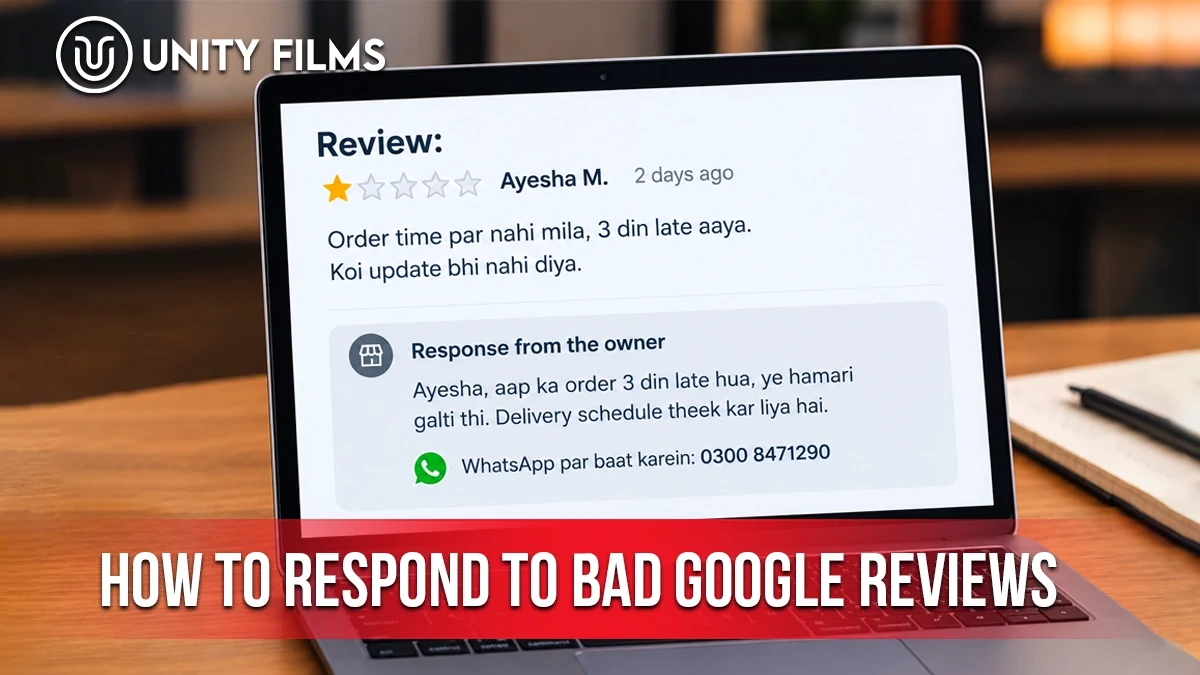
Quick answer: Knowing how to respond to bad Google reviews starts with triage. Decide first whether the review is a real customer or a policy violation, because the two need opposite actions. Real complaints get a calm public reply within 24 hours and the rest of the conversation moves offline. Policy violations get flagged with evidence, not argued with.
A one-star review lands at 11pm. Your stomach drops.
You type three angry paragraphs. You delete them. Then you paste something that starts with “We sincerely apologise for your experience and thank you for bringing this to our attention.”
Do not post that either. Every business uses it, future customers recognise it on sight, and it makes a local business sound like a call centre.
Here is what actually works, and what quietly makes things worse.
Before You Type Anything, Triage
Every guide on how to respond to bad Google reviews starts with the reply. Start one step earlier. There are two kinds of bad review and they need opposite responses, and getting this wrong is the most common mistake.
A real customer. Their story may be one-sided, exaggerated, or unfair. You can usually find some record of them. This review is not going anywhere, so your job is to write a reply that reassures everyone who reads it afterwards.
A policy violation. A competitor, a former employee, someone who was never your customer, a rant about something unrelated, or personal abuse. This one is a flagging job, not a writing job.
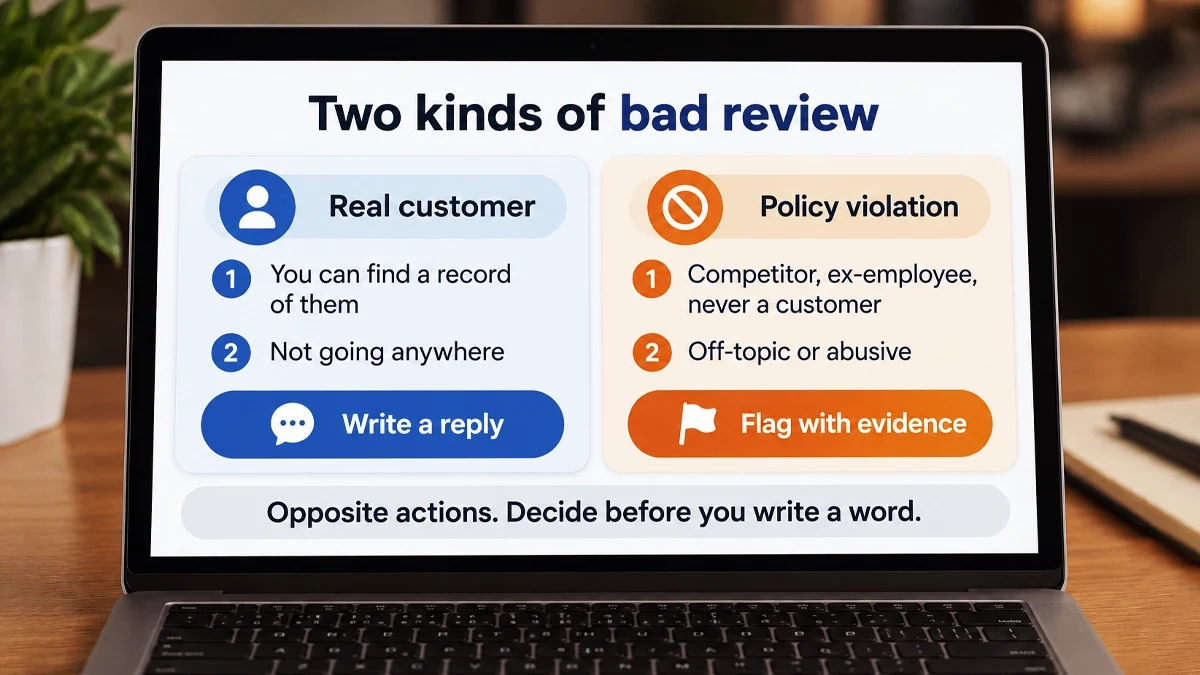
Work out which you have before you write a word. A defensive reply to a real customer damages you. A long emotional reply to a fake review gives it prominence it did not have.
Can You Actually Get a Bad Review Removed?
Usually not, and you should know that before you spend a week trying.
Google removes reviews that break a specific policy. It does not remove reviews for being harsh, unfair, exaggerated, or bad for business. A truthful complaint from a real customer stays, however much it stings.
What Google will consider removing, per its prohibited and restricted content policy:
- Spam and fake content, including reviews from people who never visited
- Off-topic content, such as rants about something unrelated to your business
- Conflict of interest, including competitors and former employees
- Harassment, threats, hate speech, or profanity
- Personal information, such as someone’s phone number or address
- Impersonation
Here is the split in plain terms.
| Google will consider removing | Google will not remove |
|---|---|
| Reviews from people who never visited | A harsh review from a real customer |
| Competitors and former employees | An exaggerated or one-sided account |
| Rants unrelated to your business | A review you disagree with |
| Threats, abuse, hate speech, profanity | A complaint you cannot find a record of |
| Someone’s phone number or address | A one-star rating with no text |
| Impersonation of another person | Anything that is simply bad for sales |
If your review does not clearly fall into the left column, stop. A calm public reply will do more for you than a failed appeal.
How Do You Flag a Review So It Actually Works?
Most self-filed reports fail, and they fail for the same reason: they say “this is fake” and nothing else. That gets rejected at the automated stage.
Screenshot everything first. Reviewer name, profile photo, star rating, the full text, and the date. People edit and delete reviews, and once it changes your evidence is gone.
Name the exact policy. Do not report it as generally unfair. Pick the most specific category that applies and report it under that one.
Attach proof. No record of the customer in your system. The reviewer’s profile showing reviews of your competitors. Dates that do not match your opening hours. A successful flag reads like a short case file, not a complaint.
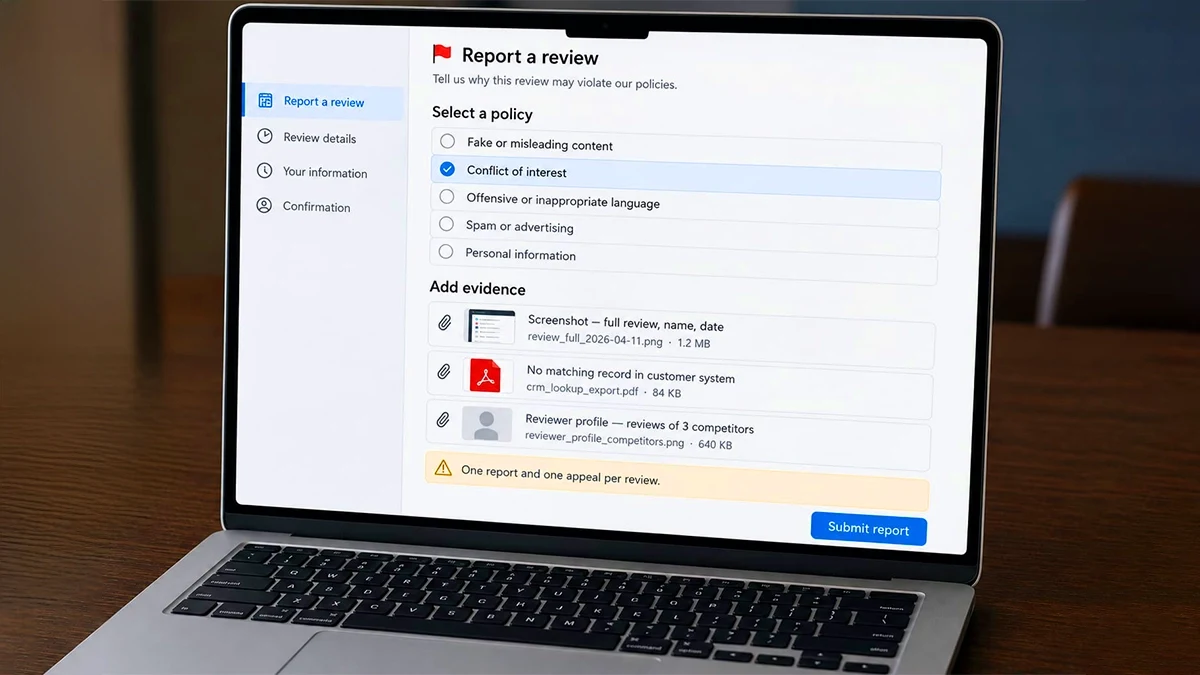
Know your limits. Google allows one removal report and one appeal per review through the Reviews Management Tool. Use the first one properly rather than firing off a weak report and burning your only appeal on it.
Expect a wait. Moderation decisions typically take a few business days, and you get an email either way.
One warning for 2026. Google’s spam detection is more aggressive than it used to be, and repeatedly flagging reviews that clearly do not violate anything draws attention to your own profile rather than theirs. Flag what is genuinely against policy. Leave the rest.
How Do You Reply to a Real Complaint?
Not a template. A structure. Four parts, short.
Acknowledge the specific thing. Not “your experience.” The actual problem, named. This alone separates you from every generic reply on the page.
Correct facts without calling them a liar. If the record differs, state what happened plainly and offer to share the details. “The work was completed on the agreed date and we have the signed schedule” is factual. “That is completely false” is an argument.
Do not reveal private details. Never post their order number, medical information, what they paid, or anything else about their dealings with you. It is a serious mistake and it is the one thing that turns a reader against you on the spot.
Move it offline, with a real route. Give a number or a WhatsApp link. Most Pakistani customers will continue on WhatsApp who would never send an email, and a complaint resolved privately sometimes becomes an edited review.
Keep it short. Almost everyone reading your reply is doing so on a phone, where a four-line paragraph fills the screen and gets skipped. Two or three short sentences land better than a careful essay nobody scrolls through.
Reply in the language they used. Roman Urdu review, Roman Urdu reply. Many owners answer formally in English believing it looks professional. To a local reader it looks like distance.
Aim for 24 hours. A one-star review sitting unanswered for a week is the first thing every new visitor reads, and silence looks like agreement.
How Do You Reply to a Fake or Competitor Review?
Differently, and much more briefly.
Reply once, calmly, for the benefit of other readers. Something to the effect that you cannot match this to any customer record and inviting them to make contact so you can look into it.
That is all. You are not arguing with them, you are showing the next reader that you checked.
Never accuse them publicly of being a competitor or a fake, even when you are certain. It reads as defensive to everyone who does not already know the context, and it does nothing to help your flag succeed. Do the accusing in the report, with evidence, where it counts.
What Never to Do
Six things, and the first one is the most common in Pakistan.
Do not bury it under fake five-star reviews. The instinct is to ask twenty friends to post glowing reviews the same week. Google’s detection now catches exactly this pattern, and a sudden burst of reviews from unrelated accounts puts your profile under scrutiny instead of the bad review.
Do not offer money, discounts, or free work to get a review removed or changed. This breaks Google’s policy, and the offer itself can be screenshotted and used against you.
Do not ask only your happy customers to post reviews. Since April 2026 this is review gating and it is explicitly prohibited. Ask everyone or ask nobody.
Do not respond emotionally, ever. Draft it, then leave it for an hour. Nothing you gain from a sharp reply outweighs a future customer reading it.
Do not ignore it. An unanswered one-star review costs you more than several unanswered five-stars gain.
Do not delete your profile or start a new listing. You lose every good review you have and you start from zero, which is a far bigger problem than the review you were escaping. If your listing genuinely needs rebuilding for another reason, how to add business on Google Maps covers doing it properly.
When Should You Not Respond at All?
There are a few, and knowing them saves you from making a bad situation permanent.
When it is extortion. Someone demanding payment to remove a review is not a customer. Do not negotiate publicly. Screenshot the demand, report it, and keep the evidence.
When you have not fixed the problem yet. If the complaint is fair and the fault is still there, a reply promising it is resolved will produce a second, angrier review. Fix it, then reply.
When there is a legal matter running. Anything involving a dispute, an injury, or a formal complaint should go past whoever is advising you before it goes public.
When you are still angry. Not never. Just not now.
Why This Affects Your Ranking, Not Just Your Reputation
Most guides on how to respond to bad Google reviews treat it as reputation management. It is also local SEO.
Review signals account for roughly 20 percent of Local Pack ranking weight in 2026, up from about 16 percent in 2023, according to Whitespark’s annual survey of local SEO experts. That is the second largest category after your profile itself. Backlinko’s local SEO guide covers how the signals fit together.
Responding does not change your star rating. It does two other things. It shows Google an active, engaged profile, and it adds text to your listing that Google can read.
So the business replying thoughtfully to every review is doing reputation work and ranking work at the same time, which is why it is worth building into a weekly routine rather than handling in a panic. The rest of that routine is in our guide on GMB optimization.
FAQs
How fast should I respond to a negative review?
Within 24 hours. Speed is visible to everyone reading the profile afterwards, and a fresh complaint with a thoughtful reply underneath reads completely differently from one that has sat alone for a week.
Will Google remove a review if it is unfair?
No. Unfair is not a policy violation. Google removes reviews that are fake, off-topic, from a competitor or employee, abusive, or contain personal information. A harsh but honest review stays, and the reply is your only tool.
Should I ask the customer to delete the review after we fix it?
You can mention that they are welcome to update it once the issue is resolved, and some do. Do not press it, and never offer anything in exchange, which breaks Google’s policy.
My competitor is posting fake reviews. What do I do?
Screenshot each one, report them individually under conflict of interest with evidence, and reply once to each calmly. Do not respond in kind by reviewing their business. That is the same violation and it puts your own profile at risk.
Working With Unity Films
Review handling is part of the profile management we do for Pakistani businesses, along with category tuning, weekly posts, photo refreshes, and the compliant review workflows that keep the good ones coming in. Our SEO service covers it.
We also handle the harder cases: suspended listings, review disputes, and profiles that have been hit with a burst of fake reviews.
If you are dealing with a review you are not sure how to answer, send us your listing before you reply to it.
Final Thoughts
Knowing how to respond to bad Google reviews is mostly about slowing down for ten minutes.
Decide what kind of review it is. Flag it properly if it breaks policy, and let it go if it does not. Reply to real complaints in a way that speaks to the next reader rather than to the person who wrote it.
The businesses with the strongest profiles are not the ones with no bad reviews. They are the ones where every bad review has a calm, specific reply underneath it, and enough good reviews around it that one complaint reads as an exception.