
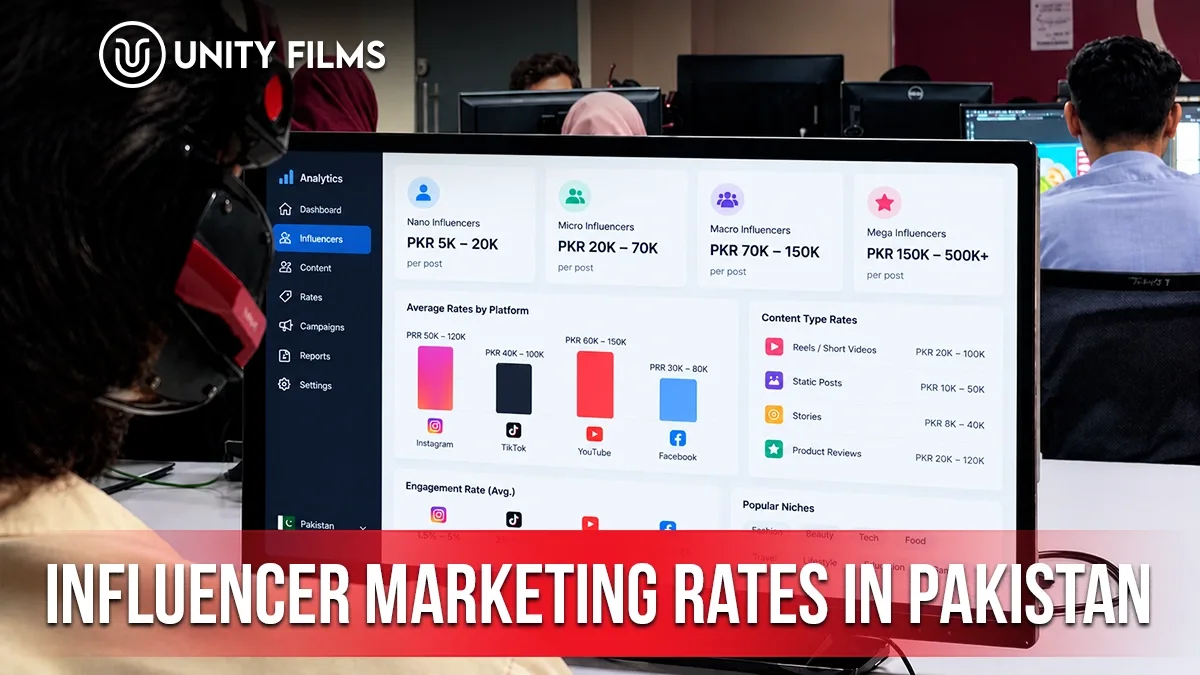
Quick answer: Influencer marketing rates in Pakistan are quoted per post by follower tier, but the tier tells you almost nothing about what you are buying. A hundred thousand followers can mean ten thousand real Pakistani people or a few thousand plus a bought audience from another country. Audit the account before you discuss a fee, not after.
Every rate guide for this market gives you the same thing: a table of follower bands with rupee ranges beside them. Nano, micro, macro, mega. Pick your tier, pay the number.
The tables are not wrong. They are just answering a question that comes second.
The first question is whether the followers exist, whether they are in Pakistan, and whether they are the kind of people who buy what you sell. Get that wrong and the rate card is irrelevant, because any price for a fake audience is too high.
This post is about that audit. It is written for the brand side: the marketing manager or business owner deciding what to pay. If you are a creator trying to work out what to charge, our guide to YouTube sponsorship rates in Pakistan covers the other side of the same table.
Why Do Influencer Marketing Rates in Pakistan Vary So Wildly?
Because there is no standard unit being sold.
Two creators both offering “one Instagram post” might be selling completely different things. One has forty thousand followers who mostly live in Lahore and reliably comment on her posts. The other has four hundred thousand, built partly through giveaway loops and engagement pods, scattered across several countries.
The second account will quote more. It is worth less.
This is not a new observation, and it is not an outsider’s complaint. In a 2021 Express Tribune feature on the Pakistani influencer market, Priceoye CEO Adnan Shaffi described a large following with low engagement as a “dead following”, and comedian Junaid Akram noted that some accounts carry audiences based largely in other countries, which cannot buy a product sold in Pakistan. That piece is several years old now and its rupee figures are long out of date, but the structural problem it described has not gone anywhere. You can read it on the Express Tribune.
The market has become more data-driven since then. That helps you only if you look at the data.
How Do You Check an Influencer’s Audience Is Real?
You can do most of this yourself, in about fifteen minutes, before any money or tool subscription is involved.
Ask for a screen recording of the account’s insights. Not a screenshot, which can be edited, and not a figure typed into a WhatsApp message. A short screen recording scrolling through the native insights panel is hard to fake and easy to provide. Any professional creator will have this ready.
Check the audience country breakdown first. This is the single most useful number and the one most brands never ask for. If you sell in Pakistan and a meaningful share of the audience is elsewhere, you are paying for reach you cannot convert.
Then check the city breakdown. A national audience is fine for an e-commerce brand shipping countrywide. For a restaurant in Islamabad it is close to worthless.
Compare reach against followers. On a healthy account, a decent share of followers see any given post. If an account has three hundred thousand followers and posts routinely reach fifteen thousand people, the following is largely inactive, whatever the reason.
Read the comments, not the count. Generic one-word comments and emoji strings repeated across posts are the signature of engagement pods and bought engagement. Real comments reference the actual content.
Look at the follower growth curve. Steady growth is normal. Vertical jumps followed by flat periods usually mean followers were bought or a giveaway brought in people with no interest in the account.
None of this requires a paid tool. A paid audit tool is useful at larger budgets, but at the scale most Pakistani businesses operate, fifteen minutes of looking properly catches the majority of problems.
What Should You Actually Be Paying For?
Shift the conversation from followers to outcomes, and influencer marketing rates in Pakistan stop being a single number you either accept or refuse.
| What you are buying | Good fit when | How to price it |
|---|---|---|
| Reach | Launching something new, nobody knows the name | Per post, judged against real reach not follower count |
| Credibility | Considered purchase, trust is the barrier | Per post, premium for genuine authority in the niche |
| Content you can reuse | You need assets for your own ads and page | Fee plus explicit usage rights, agreed in writing |
| Direct sales | Trackable product with a clear price | Commission or hybrid, with a tracked link or code |
That third row is the one most Pakistani brands underuse. A creator producing three good vertical videos about your product gives you assets you can run as paid ads for months. That is often worth more than the organic post itself, and it costs very little extra at the time of negotiation. Asking for those rights after the campaign costs considerably more.
Flat Fee, Commission, or Barter?
All three are used in Pakistan, and they suit different situations.
Flat fee is the default and the simplest. You pay for the post regardless of what it does. Reasonable when you are buying reach or credibility, where the outcome is not directly measurable anyway.
Commission pays on tracked sales. It aligns the incentive, but very few creators will accept it alone unless your product sells easily and your checkout works smoothly. If your site converts badly, the creator carries your problem, and good creators know this.
Hybrid is usually the honest answer: a reduced flat fee plus a commission or bonus on tracked sales. The creator is covered for their work, you are not paying full price for an unknown, and both sides have a reason to care about results.
Barter or free product works at the nano end and for genuinely desirable products. It stops working the moment the creator is being paid by someone else that week. Offering product-only to an established creator reads as not valuing their work, and it is usually a wasted approach.
Whatever you choose, agree the payment timeline in writing. Late payment is the most common complaint creators have about Pakistani brands, and it is why some of the better ones will not work with new clients without part payment up front.
What Should Be in the Agreement?
Short, written, and agreed before filming. It does not need to be a legal contract for small campaigns, but it does need to be explicit.
- Deliverables. Number of posts, format, and platform. “One reel and three stories” not “some content”.
- How long it stays up. A post deleted after forty-eight hours is a different product from one that stays. Say which you are buying.
- Usage rights. Can you run it as a paid ad? For how long? On which platforms? This is the clause that is cheap now and expensive later.
- Approval. Whether you see it before it goes live, and how many rounds of changes are included.
- Disclosure. The post must be marked as a paid partnership. Platforms provide tools for this, and Meta sets out how branded content tagging works in its branded content guidance.
- Payment terms. Amount, timing, and method.
On disclosure specifically: some brands ask creators to hide the partnership, believing it performs better undisclosed. It breaches platform policy, and audiences in this market are quicker than brands assume at spotting an ad. A clearly marked partnership from a creator the audience trusts performs fine.
When Influencer Marketing Is Not Right for You
Three situations where the budget does better elsewhere.
You cannot handle the enquiries. A good post produces a burst of WhatsApp messages within hours, and most of them arrive in the evening. If nobody is answering, you paid for attention and let it go cold. Sort the response process first.
Your product needs explanation, not endorsement. Influencer content works on products people can understand in a few seconds. A complex B2B service is a harder fit, and the money usually goes further on search, where people are already looking for a solution. Our SEO vs Google Ads comparison covers that choice.
You need one post to carry the whole quarter. Single posts rarely move a business. The brands that get results from this channel run several creators over several months and treat it as a channel rather than an event. If the budget only stretches to one post, consider putting it into paid social instead, where you control the frequency. Our breakdown of Facebook ads cost in Pakistan covers what that buys.
FAQs
What is a fair rate for a micro influencer in Pakistan?
There is no market-wide figure for influencer marketing rates in Pakistan, and anyone quoting one is averaging across audiences that have nothing in common. Price it against real reach rather than follower count: ask what a post typically reaches, then compare that against what the same reach would cost you in paid social. That gives you a defensible starting figure for negotiation that is grounded in your own numbers.
Should I pay before or after the post goes live?
Split it. Part on agreement, the rest within an agreed window after the content is delivered and live. Full payment up front leaves you exposed if the post never appears; full payment afterwards is why many established creators decline new brands. A split is normal and most professional creators will propose it themselves.
How do I know if followers are bought?
Look for vertical jumps in the growth curve, reach far below follower count, repeated generic comments across different posts, and an audience country breakdown that does not match the creator’s content language or location. Any one of these can have an innocent explanation. Three together is an answer.
Do influencers in Pakistan issue invoices?
Established creators and agencies generally do. Smaller creators often do not, which matters for your own bookkeeping and withholding obligations. Agree the paperwork at the same time as the fee, and check with your accountant how payments to individuals should be treated before the campaign, not at year end.
Is TikTok or Instagram better for this in Pakistan?
It depends entirely on who you sell to, and the honest answer is that you should check where your own customers are rather than follow a general rule. Ask five recent customers which apps they use. That sample is small, but it is about your actual buyers, which makes it more useful than a national statistic.
Working With Unity Films
We run influencer campaigns for brands as part of our digital marketing work, and the audit described above is the first thing we do on any proposed creator, before a rate is discussed. Quite often it ends the conversation, which saves the client the fee.
We also produce the content side, so when a campaign needs assets the creator cannot shoot, that happens in-house rather than through a third party. That matters mostly for scheduling: one team means the shoot, the edit and the posting calendar are not waiting on each other.
The service sits under influencer marketing, and the broader channel mix under digital marketing services.
Agar aap ke paas pehle se kisi creator ka naam hai aur sirf yeh janna hai ke uski following asli hai ya nahi, to WhatsApp par naam bhej dein. Audit kar ke bata denge, chahe campaign hamare saath na ho.
Final Thoughts
Influencer marketing rates in Pakistan will keep being published as tidy tables, and the tables will keep being the least useful part of the decision.
Audit the account first. Country breakdown, city breakdown, reach against followers, the texture of the comments, the shape of the growth curve. Fifteen minutes.
Then negotiate, on real reach rather than follower count, and get usage rights in the agreement while they are still cheap.
The rate matters. It just matters third.