
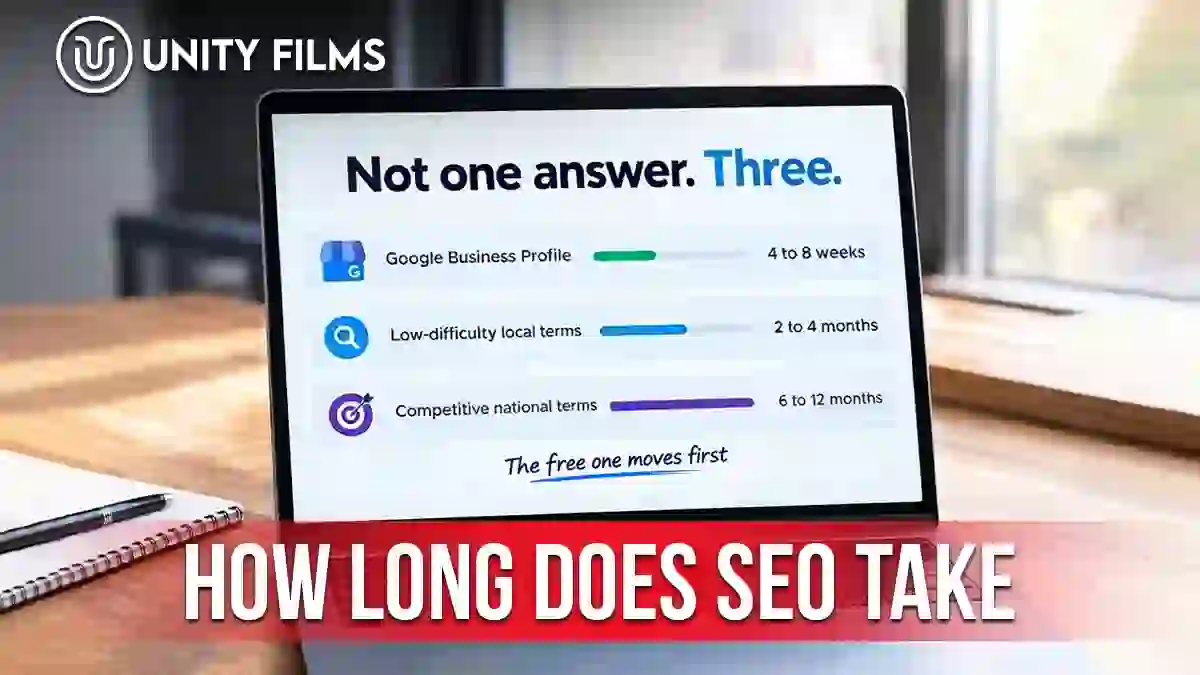
Quick answer: How long does SEO take is usually answered as three to six months, and that figure comes from saturated Western markets. In Pakistan, keyword competition is far lower, so low-difficulty local terms often move faster. Your Google Business Profile can produce calls in four to eight weeks. Competitive national terms still take six to twelve months.
Every agency gives you a range. Three to six months. Four to twelve. It depends.
None of them tell you where that number came from, and it matters, because almost every figure you will read was calculated in markets where you are competing against sites with a decade of backlinks.
That is not the market you are in.
This guide gives you a timeline built for Pakistan, what moves first, what takes the longest, and how to tell at month three whether it is working or whether you are being managed rather than helped.
Why Do the Published Timelines Not Fit Pakistan?
The global consensus is three to six months, supported by real research. Search Engine Land’s guide puts it at three to six months for measurable results and six to twelve in competitive industries. WebFX notes that the typical top-ten ranking page is around two years old, and pages ranking first are closer to three.
Those numbers are accurate. They are also measured in markets where every competitor is already doing SEO properly. WebFX’s breakdown of the same question reaches a similar range from a different dataset.
So when someone answers how long does SEO take with a single global figure, they are quoting research from a market that does not resemble yours.
In Pakistan, a large share of commercially valuable keywords sit at low difficulty. In our own research for this site we routinely find terms with real search volume and difficulty scores in the teens and low twenties. In the US, the equivalent term would be fought over by established sites with years of authority behind them.
Here you are often competing against businesses with no website at all, or one that has never been optimised, or a page that has not been touched since 2021.
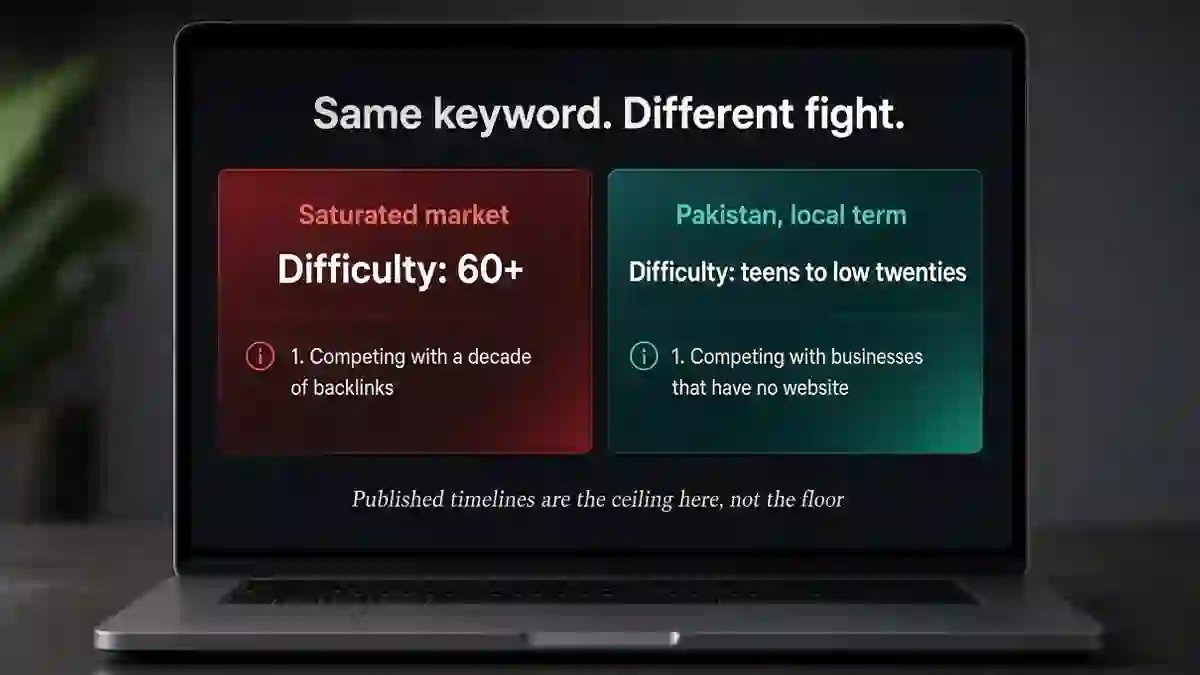
So the honest version is this. The published timelines are the ceiling for Pakistan, not the floor. Competitive national terms still take the full six to twelve months. Local and low-difficulty terms frequently move considerably faster than a global article will tell you.
What Is the Realistic Month-by-Month Timeline?
For a local or service business in Pakistan, assuming the work actually happens every month.
| Period | What is happening | What you should see |
|---|---|---|
| Weeks 1–4 | Audit, technical fixes, Google Business Profile, tracking setup | Profile activity, possibly first calls |
| Months 2–3 | Service and area pages published, on-page work | Low-difficulty terms start appearing |
| Months 3–4 | Content compounding, early links | First organic enquiries, usually from unexpected pages |
| Months 4–6 | Patterns visible, targeting refined | Steady enquiry flow from several pages |
| Months 6–12 | Competitive terms move | Volume grows on work already done |
Two things about that table are worth saying plainly.
The first month produces nothing you can see, and that is normal rather than a warning sign. If your agency shows you a dramatic traffic chart in week three, ask what changed, because usually nothing has.
The Google Business Profile is the exception to everything. For a shop, salon, clinic or showroom, it commonly produces calls within four to eight weeks, which is far faster than anything else on this list and costs nothing. Our guide on GMB optimization covers that work, and how to add business on Google Maps covers setup.
Why Do Most Businesses Give Up Too Early?
Because of a gap between what owners expect and what is possible.
HigherVisibility’s research on small businesses found that 68.8 percent of SMB owners expect results in under three months. Almost seven in ten are expecting an outcome in a window where, by every published measure, very little is visible yet.
So month three arrives, the traffic chart is unimpressive, and the business concludes SEO does not work. They stop, and everything built so far quietly decays.
There is a second trap on the other side of that. A Semrush study found that while 41 percent of domains studied reached the top ten within six months, only 27 percent were still there by the end of the thirteen-month study. Arriving is not the same as staying. SEO that stops the month you hit page one usually does not stay on page one.
Neither of those numbers is a reason not to do SEO. They are reasons to fund it properly or not start.
What Actually Decides Your Timeline?
Five things decide how long does SEO take for your specific site, in order of impact.
Keyword difficulty. The single biggest factor and the most controllable. A business targeting “digital marketing agency” nationally and one targeting “packers and movers I-8 Islamabad” are not on the same timeline at all.
Your site’s age and history. A domain with two years of clean history moves faster than one registered last month. Google needs time to work out what a new site is.
How much gets published. Three pages and then nothing flattens out. Consistency beats intensity here.
Your starting point. A site with technical problems spends months one and two on repairs before any growth work begins. That is not wasted, but it does move everything back.
Whether anyone on your side makes decisions. Approvals, access, content sign-off. Agencies stall on client silence more often than on algorithms.
How Do You Tell at Month Three If It Is Working?
This is the most useful question on this page, because month three is when most businesses quit and most of them are quitting too early.
Asking how long does SEO take is less useful at this point than asking whether it is moving at all. Do not look at traffic. Look for these instead.
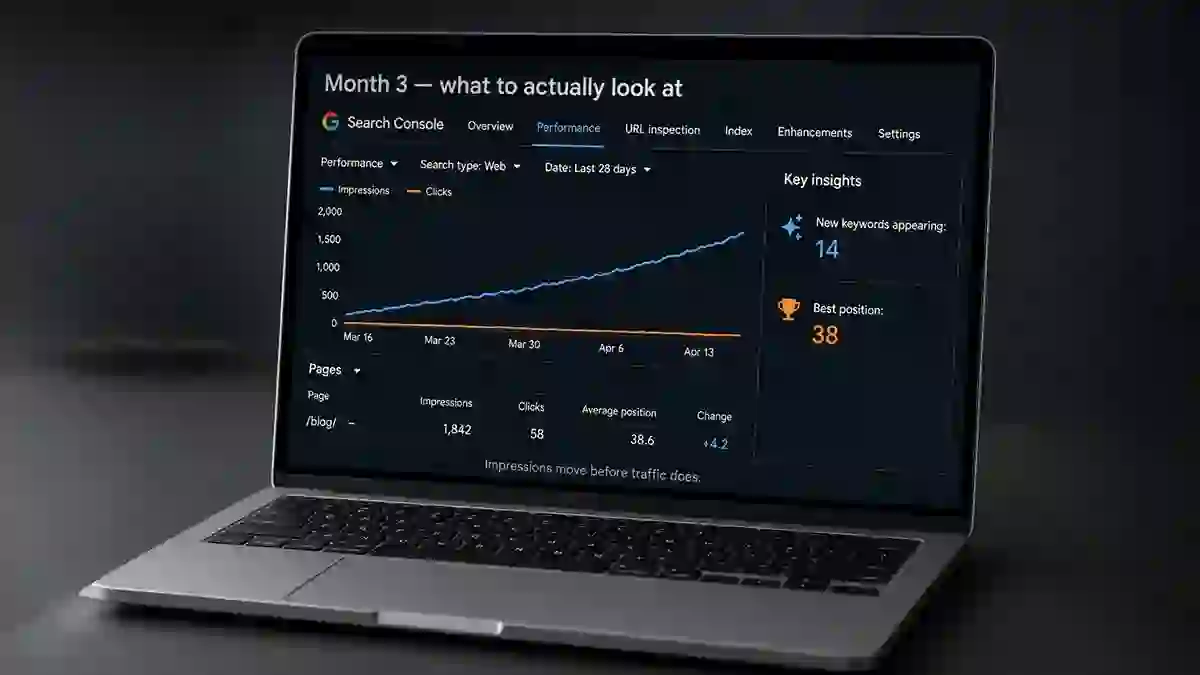
Impressions rising in Search Console, even if clicks are not. This means Google is starting to show your pages. It is the earliest real signal and it arrives before traffic does.
New keywords appearing at all, even at position 40. Movement from nowhere into the rankings matters more at this stage than movement within page two.
Google Business Profile activity climbing. Discovery searches, direction requests, calls. These move first.
Pages actually published. Count them. If the plan said eight pages and four exist, the timeline is not the problem.
One honest conversation about what is not working. An agency running the exact plan it proposed in month one has not been reading the data.
If impressions are flat, no new keywords have appeared, and nothing has been published, three months is enough to conclude something is wrong. That is a different finding from “SEO does not work”.
When SEO Is the Wrong Choice for Your Business
Sometimes the timeline itself is the answer.
You need customers this month. SEO cannot help you. Ads produce leads in the first week, and that is a different tool for a different problem. Our comparison of SEO vs Google Ads covers choosing between them.
Your budget only covers three months. By every measure on this page, month three is where the least visible progress has been made. Funding the slow part and quitting before the payoff is the most expensive way to do this.
Nobody on your side can give it an hour a week. Approvals and access are your job. Without them the work stalls regardless of who you hired.
Your Google listing is empty. Fix that first. It is free and it works in weeks.
Your business changes direction every quarter. SEO compounds on a consistent target. If what you sell shifts every few months, the work resets with it.
FAQs
How long does SEO take for a brand new website?
Longer than for an established one. Expect six to twelve months for meaningful organic traffic, because Google needs time to assess a new domain. Google’s own guidance has long put the range at four months to a year. A new site targeting low-difficulty local terms in Pakistan can beat that, but do not plan around it.
Can SEO work faster than three months?
Yes, in two specific cases. Google Business Profile work commonly produces calls in four to eight weeks. And genuinely low-difficulty keywords, which are far more common in Pakistan than in Western markets, can rank within two to three months. Competitive terms cannot be rushed.
If I stop SEO after ranking, do I lose the rankings?
Not immediately, but usually yes over time. Traffic decays slowly rather than stopping, and competitors who keep working overtake you. The Semrush finding above, where most domains reaching the top ten had left it within thirteen months, is what that looks like in data.
Is SEO still worth it now that AI Overviews answer questions directly?
The goal has shifted rather than disappeared. Ranking still matters, and being the source an AI answer draws from matters alongside it. Both reward the same thing: clear pages that answer real questions with sourced information.
Working With Unity Films
We tell clients the same timeline on the first call that is written on this page, including the part where months one to three look like nothing is happening.
Our SEO service starts with keyword difficulty rather than keyword volume, because in Pakistan that is where the speed comes from. Targeting a low-difficulty term with real intent will produce enquiries months before a high-volume national term moves at all.
We will also tell you when the timeline does not fit your situation. If you need customers this quarter, we will say so rather than selling you a six-month plan.
If you want a read on how long your specific keywords would realistically take, send us your website.
Final Thoughts
How long does SEO take has a real answer, and it is not one number. Your free Google listing moves in weeks. Low-difficulty local terms move in two to four months. Competitive national terms take six to twelve.
The mistake is not misjudging the timeline. It is quitting at month three while looking at the wrong metric. Impressions and new keyword appearances tell you whether it is working long before traffic does.
Decide before you start whether you can fund twelve months. If the answer is no, spend the money on something faster and come back to this when you can.