
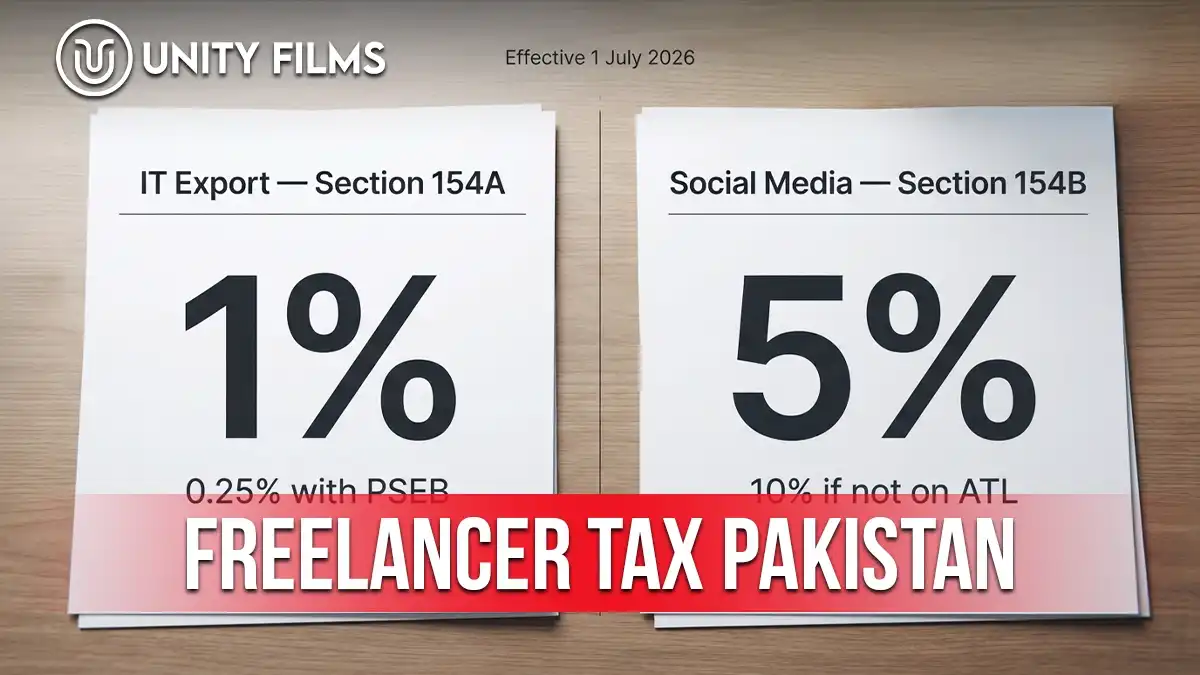
Quick answer: Freelancer tax Pakistan now runs on two separate tracks. Client work exported as IT services is taxed at 1 percent, or 0.25 percent with PSEB registration. But from 1 July 2026, YouTube and social media earnings were pulled out of that regime under Section 154B and are taxed at 5 percent for filers and 10 percent for everyone else.
If you freelance on Fiverr and your cousin runs a YouTube channel, you used to be taxed the same way. Since July, you are not.
The Finance Act 2026 quietly split Pakistan’s digital earners into two groups with wildly different tax rates. A developer invoicing a foreign client pays a fraction of a percent. A creator earning the same amount from YouTube pays multiples of it. Most people in both groups still do not know this happened.
This guide covers both tracks, what decides which one you land in, and the single piece of paperwork that halves your rate.
One note before we start. This is general information, not tax advice. Rates change with every Finance Act. Confirm your own position with a registered tax consultant or directly with FBR before you file.
What Is Freelancer Tax in Pakistan?
Start here, because the term itself is misleading. FBR does not have a category called “freelancer,” so freelancer tax Pakistan is not a rule in the Ordinance. It is shorthand for whichever regime your income lands in. For tax purposes you are an individual earning business income. What matters is not what you call yourself, but how the money reaches you and what it was paid for.
If you export IT or IT-enabled services and the money arrives through official banking channels, you fall under Section 154A. This is the concessionary regime, and the rates are among the lowest on any earned income in Pakistan.
| Your status | PSEB registered | Rate under 154A |
|---|---|---|
| Filer, on ATL | Yes | 0.25% |
| Filer, on ATL | No | 1% |
| Non-filer | Yes | 0.5% |
| Non-filer | No | 2% |
These are final tax rates on gross receipts, not on profit. The Finance Act 2026 extended this regime through Tax Year 2029, so it is stable for the next three years.
Two conditions decide whether you qualify. The income has to genuinely be for IT or IT-enabled services. And the payment has to arrive through an approved banking channel. Money that comes through hundi or informal routes does not just lose the rate. It can be treated as unexplained income.
Pakistan’s tax-free threshold for individuals is Rs 600,000 a year. Below that you owe nothing, but registering and filing is still worth doing, because ATL status changes what you pay on banking, property, and vehicle transactions.
YouTube Tax Pakistan: What Changed on 1 July 2026
Here is the part almost nobody has caught up with.
The Finance Act 2026 inserted a new Section 154B into the Income Tax Ordinance 2001, placed directly after 154A. It is titled withholding tax on revenues received from social media platforms, and it took effect on 1 July 2026, the start of Tax Year 2027.
What it does is simple and severe. Your bank deducts the tax before the money reaches you. Every banking and non-banking financial institution in Pakistan is now required to deduct at the moment any amount is credited to your account where that amount represents revenue from a social media platform. YouTube, Facebook, Instagram, and TikTok are named directly.
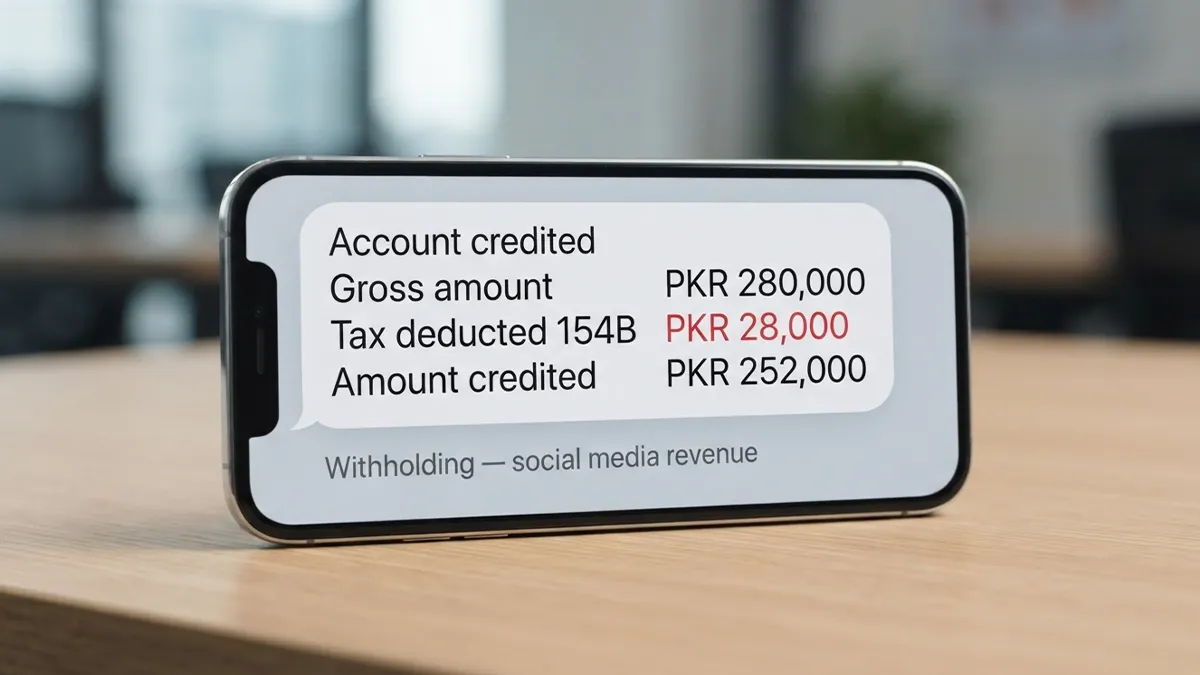
The important word is decoupled. Creator earnings were carved out of the IT export regime deliberately, not by accident. The same Act that extended the 0.25 percent rate for software exporters until 2029 removed creators from it in the same breath. Business Recorder’s coverage of Section 154B and ProPakistani’s reporting both walk through the drafting.
So a Pakistani YouTuber and a Pakistani Fiverr freelancer earning identical amounts now sit in different regimes, at rates that differ by a wide margin.
What Is the Tax on YouTube Income in Pakistan?
The rate depends entirely on one thing: whether your name is on the Active Taxpayers List.
| Your status | Rate deducted at the bank |
|---|---|
| On the ATL | 5% |
| Not on the ATL | 10% |
FBR’s Withholding Tax Rates Card, issued on 11 August 2026, confirms the split.
Now the part that catches people out. For a resident creator, that 5 percent is minimum tax, not final tax. Those two words do very different things.
Minimum tax means the deduction sets a floor. It counts toward your annual liability, but your tax on that income cannot fall below it. If your properly computed tax works out higher, you pay the difference at filing. If it works out lower, the 5 percent stands. You do not get the excess back, you cannot carry it forward, and you cannot adjust it against anything else.
For a non-resident creator with no permanent establishment in Pakistan, the 5 percent is final tax. The matter closes there, with no expense claims and no refund.
What is not covered by 154B. Two things sit outside it. Work you invoiced a client for, received as an IT or IT-enabled export, is still 154A income. And a sponsorship paid to you by a Pakistani brand in rupees is ordinary domestic business income, not platform revenue. Getting this split right on your return matters, because the wrong classification either overpays or invites a correction later.
Why Does ATL Status Matter So Much?
Look at the two tables again. Every single row of freelancer tax Pakistan improves if you are on the Active Taxpayers List.
For a creator it is the difference between 5 percent and 10 percent. Your rate is literally halved by a filing status. For a freelancer under 154A it is the difference between 1 percent and 2 percent, or between 0.25 percent and 0.5 percent.
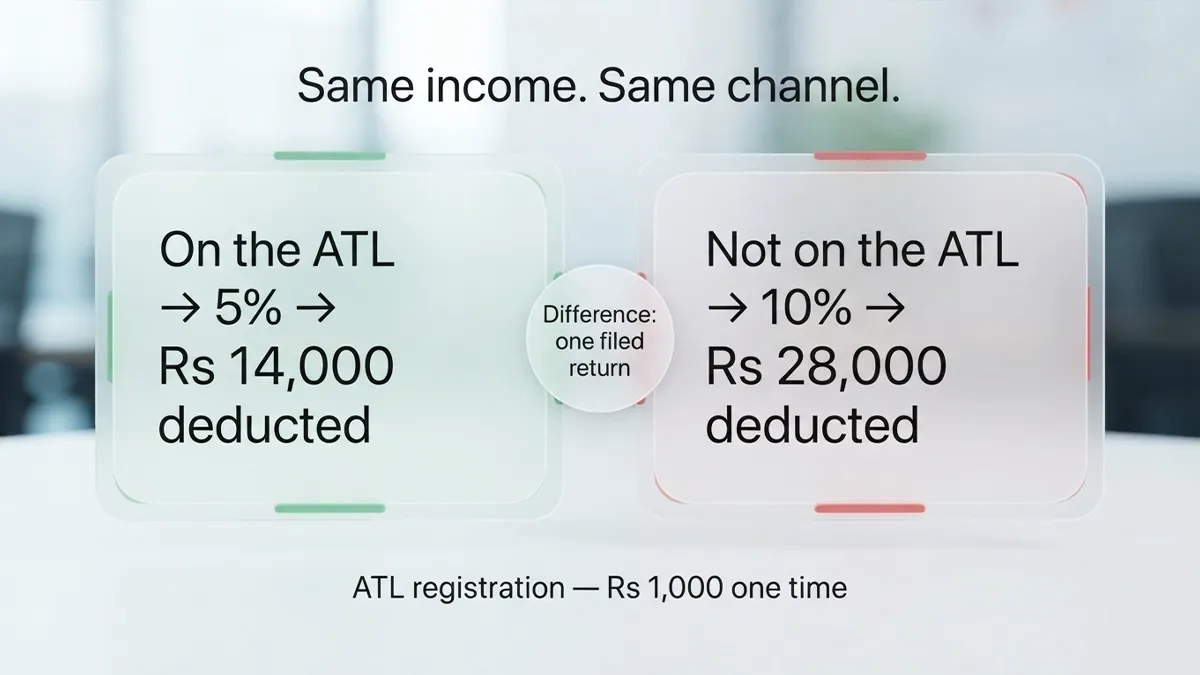
Getting on the ATL costs a one-time fee of Rs 1,000 and requires that you file a return. Nothing about your earnings has to change. It is paperwork, and it is the highest-return paperwork available to anyone earning online in Pakistan right now.
This is where most creators lose money without noticing. The deduction happens at the bank, silently, at the moment the payment lands. Nobody sends you a notice saying you paid double because you never filed. Aap ko pata bhi nahi chalta, paisa kam ho kar aata hai aur baat khatam.
Which Track Are You Actually On?
Read down and stop at your first honest yes.
| Your situation | Your regime |
|---|---|
| I invoice foreign clients for design, dev, writing, or editing | 154A, IT export |
| I earn from YouTube, TikTok, Instagram, or Facebook monetisation | 154B, 5% or 10% |
| I do both | Both, split on your return |
| A Pakistani brand pays me in rupees for a sponsored video | Ordinary business income, neither |
| I get paid through hundi or a friend’s account | No concession, and a bigger problem |
The third row is where most Unity Films clients actually sit. A creator with a monetised channel who also takes editing or production work from abroad has income in two regimes at once, and the return has to reflect that.
How Do You Register and File?
Four steps, in order. None of them require a consultant, though a consultant is worth it once your income is meaningful.
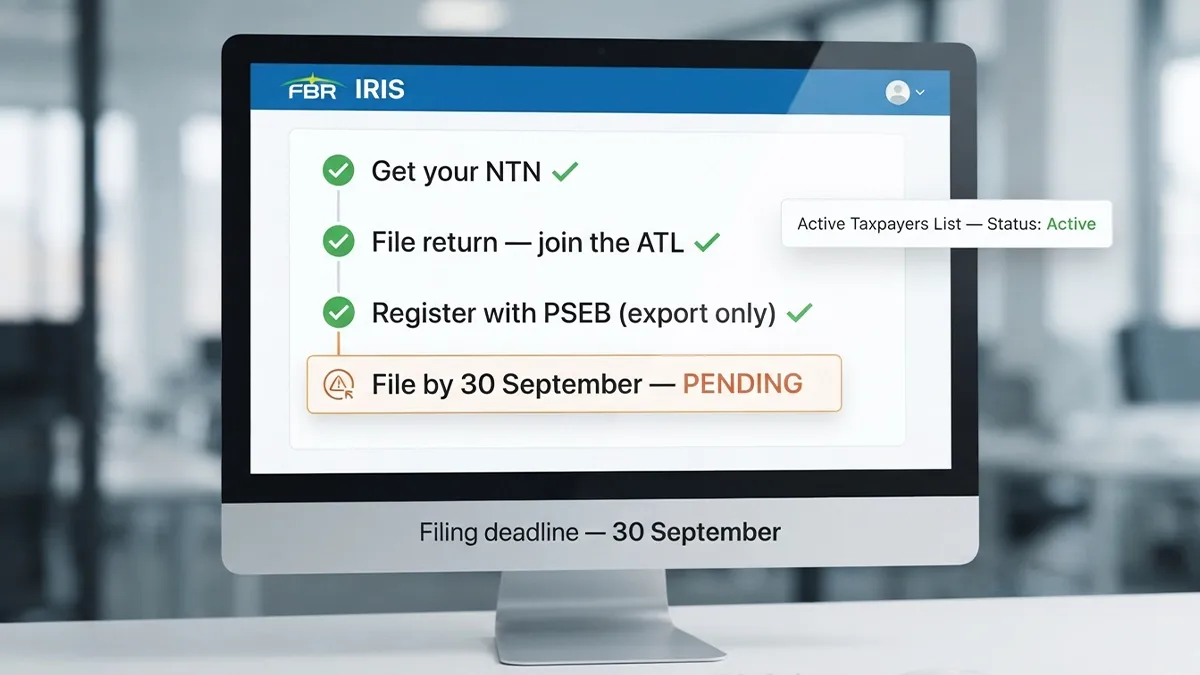
1. Get your NTN. Register through FBR’s IRIS portal at fbr.gov.pk. Select your business type as freelancing, IT services, or software export, whichever fits.
2. Get on the ATL. File a return and pay the Rs 1,000 fee. Your name appears after FBR’s next list update. This single step halves your creator rate.
3. Register with PSEB if you export services. pseb.org.pk handles it online and it typically takes around two weeks. This takes 154A income from 1 percent to 0.25 percent. It does nothing for 154B creator income, so if you only earn from monetisation, skip it.
4. File by 30 September. This is the annual deadline for the previous tax year, and it is the date competitors mention most and creators miss most. FBR sometimes extends it, but planning around an extension is how people end up off the ATL. Late filing carries penalties and can cost you your ATL status, which pushes your creator rate straight back from 5 percent to 10 percent on every payment until you are reinstated.
Case Study: A Rawalpindi Creator With Income in Both Regimes
A creator we work with in Satellite Town Rawalpindi runs a monetised YouTube channel and also takes video editing work from clients in the Gulf.
He had never filed. His AdSense payments were arriving with a deduction he had not noticed, and his editing income was going into the same personal account as everything else. When he asked why his payouts looked short, he assumed his bank was charging him.
What changed over one filing cycle:
- Registered for an NTN and filed a return, which put him on the ATL
- Creator withholding dropped from 10 percent to 5 percent on every payment after that
- Registered with PSEB, which brought his client editing income under the 0.25 percent rate rather than 1 percent
- Opened a separate account for client work so the two income types stopped mixing
- Filed with the two streams split correctly, 154B for the channel and 154A for the editing
Nothing about how much he earned changed. Only how much reached him did.
FAQs
Do I have to pay tax if I earn less than Rs 600,000 a year?
The threshold means no income tax is due below that level. It does not mean the bank stops deducting. Section 154B withholding happens at credit regardless of your annual total, so a small creator who has never filed still loses 10 percent at the bank. Filing is how you claim your position back.
Is the 5 percent on YouTube income refundable?
For a resident, no, not as an excess. It is minimum tax, so it sets a floor. If your calculated liability is higher you pay the difference. If it is lower, the 5 percent already taken is what you pay, and it cannot be refunded, carried forward, or adjusted.
Does PSEB registration reduce my YouTube tax?
No. PSEB applies to IT and IT-enabled exports under 154A. Creator monetisation was deliberately removed from that regime. If your only income is from YouTube monetisation, PSEB registration will not change your rate, though it still matters if you also invoice clients.
What happens if I have never filed anything at all?
You pay the higher rate on every payment until you fix it, and the deductions already taken are still deducted. Getting an NTN and filing is the fastest financial decision available to you, because the rate change applies to everything credited from that point onward.
Working With Unity Films
We manage YouTube channels for creators across Pakistan, so we see this problem constantly. A creator’s payments arrive short, they assume the platform or the bank is at fault, and nobody has told them the deduction is a tax rate tied to a filing status.
We are not tax consultants and we will not file your return. What we can tell you is which of your income streams is creator revenue and which is service export, because that split starts with how your channel and your client work are actually structured. Your YouTube settings and payment setup decide which bucket the money arrives in. Our guide on Google AdSense Pakistan payments covers the payment side that sits underneath all of this, and our YouTube channel management work covers the growth side.
If you want to talk through how your channel income is structured, get in touch.
Final Thoughts
Freelancer tax Pakistan is no longer one question with one answer. The rules changed on 1 July 2026 and most Pakistani creators still do not know. The gap between 5 percent and 10 percent is a filing status. The gap between 1 percent and 0.25 percent is a PSEB registration that takes two weeks.
Neither requires you to earn a single rupee more. Both require paperwork that most people keep postponing because the money still arrives either way.
Confirm your own position with a registered tax consultant or with FBR before filing. Rates move with every Finance Act, and this one moved more than most.