
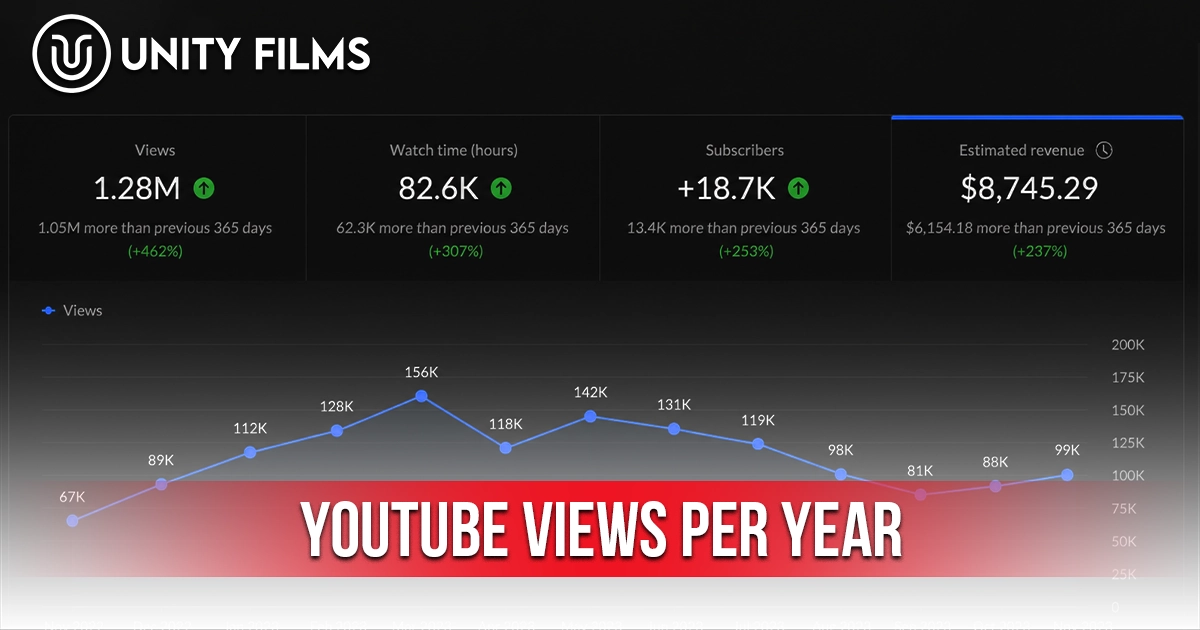
Most creators plan in weeks. They upload weekly, review weekly, and worry about weekly numbers. But YouTube views per year is the metric that actually tells you whether your channel is a hobby that pays for coffee or a career that pays for a life. It’s the long-term measurement that reveals compounding, tests niche viability, and quietly separates channels that survive from channels that fade.
Across channels we’ve worked on, the ones that turned into full-time careers all shared one habit: they tracked their annual view totals from year one, even when the number was embarrassingly small. Year one might be 50,000 total views. Year two, 500,000. Year three, 5 million. That non-linear compounding curve doesn’t reveal itself in daily, weekly, or even monthly data. It only shows up when you zoom out to the year.
This guide walks through what YouTube views per year means, how it fits alongside your daily, weekly, and monthly tracking rhythm, realistic annual benchmarks by channel size, why yearly data is what sponsors and brand partners really want, and the contrarian truth about what a good annual number actually looks like in 2026.
Quick Answer: How Many YouTube Views Per Year Is Considered Good?
There’s no universal “good” number for YouTube views per year. Healthy annual views depend on channel size, niche, upload consistency, library depth, and how long the channel has existed. Use these brackets as a rough reference, not a fixed rule.
| Channel Stage | Subscribers | Typical YouTube Views Per Year |
|---|---|---|
| New channel (year 1) | Under 1,000 | 1,800 to 20,000 |
| Small channel | 1,000 to 10,000 | 20,000 to 200,000 |
| Growing channel | 10,000 to 100,000 | 200,000 to 2,000,000 |
| Established channel | 100,000 to 1M | 2M to 20M |
| Major channel | 1M+ subscribers | 20M to 500M+ |
These brackets work out to roughly 12x your monthly view bracket. The spread within each tier is wide because niche compounding, upload consistency, and library depth all shift the ceiling significantly. A channel uploading twice weekly for two years will nearly always have bigger annual numbers than one uploading weekly for the same period.
For the full daily-to-yearly progression, our other guides cover each layer: YouTube views per day for real-time momentum, YouTube views per week for tactical patterns, and YouTube views per month for revenue and sponsorship planning. Yearly views sit on top of all three the trajectory layer that decides whether the whole channel is going somewhere.
What Are YouTube Views Per Year?
YouTube views per year is the total number of times your videos are watched across your channel during a 12-month window. You can find this in YouTube Studio under Analytics → Overview by setting the date range to the last 365 days. Most creators also compare calendar years January 1st to December 31st of the previous year — because it aligns with tax planning, sponsorship negotiations, and personal financial review.
Where daily, weekly, and monthly views all measure recent performance, yearly views measure something entirely different: trajectory. They tell you not where the channel is, but where it’s going. A channel with 500,000 annual views isn’t the same as a channel with 500,000 annual views one might be on the way to five million, the other on the way to two hundred thousand. Only year-over-year comparison can tell them apart.
Why creators should track YouTube views per year:
- It reveals compounding. According to independent creator economy research, YouTube growth is deeply compounding and non-linear. Year-over-year data is the only view that shows this properly.
- It tests niche viability. Three consecutive years of growth means the niche and audience are real. Three years of flat numbers means it’s time to pivot.
- It supports major business decisions. Full-time transitions, hiring, equipment investment, and long-term brand deals all reference annual view data.
- It matches how the industry measures success. Media kits, sponsor pitches at the enterprise level, and creator awards use annual numbers, not monthly ones.
Honestly, the data on year-over-year variance is messier than most guides admit. Some channels double annually for three years and then plateau. Others creep for two years, then explode in year three. Both patterns are normal. What matters is direction over multiple years, not a single 12-month snapshot.
YouTube Views Per Year vs Per Month vs Per Week vs Per Day
These four metrics each answer a completely different question, and using the wrong one at the wrong time leads to bad decisions. The honest hierarchy:
| Metric | Time Window | Best Used For |
|---|---|---|
| Daily views | 24 hours | Real-time monitoring, ad revenue, spotting outliers |
| Weekly views | 7 days | Content decisions, tactical adjustments |
| Monthly views | 30 days | Revenue forecasting, sponsorship pitches |
| Yearly views | 365 days | Trajectory, career decisions, niche viability |
Daily views tell you the moment. Useful for AdSense tracking and noticing viral spikes. Too noisy for anything else.
Weekly views tell you the pattern. Useful for judging whether recent content shifts are working, and adjusting cadence.
Monthly views tell you the health. Useful for revenue calculations and sponsor negotiations, since AdSense and brand deals both operate on monthly financial cycles.
Yearly views tell you the trajectory. Useful for deciding whether to go full-time, invest in a team, pivot niches, or scale into new content formats. Nothing else can answer these questions honestly.
Smart creators check daily views for revenue, weekly views for content, monthly views for business, and yearly views for career. Mixing them up using yearly numbers as a tactical guide, or monthly numbers as a career decision wastes energy and produces bad calls. Our full YouTube channel stats guide walks through the wider metrics framework that pairs with all four time windows.
Realistic Year-Over-Year Growth Curves
The pattern below shows what a healthy channel’s yearly view trajectory usually looks like in the first five years. These aren’t universal they vary by niche, upload consistency, and content format but they capture the compounding pattern that shows up across the majority of channels that eventually break through.
| Year | Typical Annual Views | What’s Driving It |
|---|---|---|
| Year 1 | 1,800 to 25,000 | Subscribers + small algorithm tests |
| Year 2 | 25,000 to 250,000 | Library building + first winners |
| Year 3 | 250,000 to 2 million | Compounding + niche recognition |
| Year 4 | 2 million to 10 million+ | Library maturity + returning viewer base |
| Year 5+ | 10 million to 100 million+ | Full compounding + brand authority |
Notice the shape. Growth isn’t linear it’s exponential when it works. The first year is almost always painful. The second year usually shows the first real signs. The third year is where compounding becomes visible. Most creators who quit do so between month 9 and month 18 right before the second year starts paying off.
According to Hootsuite’s YouTube industry data, the platform now hosts over 2.6 billion monthly active users, and the average YouTube channel takes about 15.5 months to reach 1,000 subscribers. That timeline compresses dramatically for channels combining Shorts with long-form content, and expands for channels in over-saturated niches. Neither extreme changes the underlying compounding structure it just shifts the timeline by 6 to 18 months in either direction.
I’m not 100% convinced these brackets hold for every niche in every country, but they’re roughly the trajectory most channels that eventually succeed follow. The direction — steady exponential growth — matters much more than the specific numbers in any given year.
What Affects YouTube Views Per Year (And Why Yours Are Normal)
Annual view totals are shaped by six long-term factors, not by any single video or upload. These are the levers that actually move yearly numbers.
- Consistency across the full 12 months. A channel uploading twice weekly for 52 weeks straight dominates a channel uploading twice weekly for 20 weeks and then disappearing. Consistency compounds. Gaps kill compounding.
- Library depth entering the year. A channel starting with 100 videos compounds from a much bigger base than one starting with 20 videos.
- Niche audience size. Personal finance, tech, education, and lifestyle have massive annual audiences. Highly specialized niches have smaller ceilings but often better returning viewer ratios.
- Content format mix. According to Statista’s YouTube data, over 500 hours of video are uploaded every minute. Channels running both Shorts and long-form typically pull 3-5x higher annual view totals than long-form-only channels at the same subscriber count.
- Algorithm shifts within the year. YouTube’s distribution logic changes across 12 months. A niche that thrived in Q1 might slow in Q4, and vice versa.
- External catalysts. A single Shorts hit, a mention on a bigger channel, a news event tied to your niche these can add hundreds of thousands of views totally outside any strategy you controlled.
The honest test isn’t whether your annual views match some external benchmark. It’s whether they’re trending up compared to your own previous year. Year 2 higher than Year 1. Year 3 higher than Year 2. External comparisons are mostly noise.
Why Yearly Views Matter for Career and Business Decisions
Here’s where yearly tracking earns its place. Monthly views handle sponsor pitches. Yearly views handle the bigger questions.
Decision 1: Can I Go Full-Time on YouTube?
The honest math: if your channel has produced consistent monthly income for 12+ months and yearly views have grown in a healthy trajectory, the numbers support a full-time transition. Anything less, and the transition usually fails because monthly variability without an annual growth trend is a sign of luck, not compounding. Yearly view data is what separates the two.
Decision 2: Should I Invest in a Team or Better Equipment?
Reinvestment decisions need annual data. A single strong month can trick you into over-investing. A single weak month can trick you into under-investing. Only 12 months of yearly view and revenue data give you the base to make big spending calls confidently. Our guide on YouTube automation for beginners covers the production workflow choices that scale most cost-effectively at each yearly view tier.
Decision 3: Is My Niche Still Viable Long-Term?
Three consecutive years of flat or declining annual views is a serious signal usually meaning either the niche has hit its ceiling or the audience has moved on. This is different from a bad month or a slow quarter. It’s a structural signal that requires a strategic response. Our best faceless YouTube niches for 2026 breakdown covers the alternative niches that show strong long-term compounding potential.
Decision 4: Am I Getting Paid What I’m Worth?
Sponsors and brand deal partners at higher tiers negotiate on annual reach, not monthly. If a brand knows your channel pulled 5 million views last year, they’ll pitch you at a completely different rate than if they only see a single month’s data. Yearly view totals give you the leverage to charge properly. Our YouTube video ideas guide covers the content mix that maintains yearly growth even as niche competition tightens.
How to Track YouTube Views Per Year in YouTube Studio
Tracking annual views is simple but requires a habit most creators skip.
From desktop:
- Step 1: Open YouTube Studio at studio.youtube.com
- Step 2: Click Analytics in the left sidebar
- Step 3: Change the date range to Last 365 days, or select Custom and pick January 1st to December 31st for calendar-year comparison
- Step 4: Note the Views, Watch time, and Subscribers gained numbers
- Step 5: Use the Compare to option to overlay the previous 365 days for year-over-year comparison
A habit that pays off enormously: at the end of every calendar year, save a screenshot of the previous 365 days plus the year-over-year comparison. Six years of these screenshots become the most credible growth chart you’ll ever hand to a sponsor, agent, or business partner.
The Contrarian Truth About YouTube Views Per Year
This is where most guides get it wrong. They frame annual view totals as the finish line. They aren’t.
Annual views are a lagging indicator, not a leading one. By the time your yearly number reveals a problem, you’ve already spent 12 months producing content that wasn’t compounding. By the time it reveals a success, you’re already in the pattern that generated it. Yearly data is what you use for career and business decisions but you can’t use it to fix problems in real-time.
The honest hierarchy of what yearly views actually measure:
- 50% of yearly view totals come from your library — how many videos you’ve published and how well old ones compound.
- 30% comes from that year’s upload cadence and consistency.
- 15% comes from Shorts distribution and algorithm surprises.
- 5% comes from external catalysts — viral moments, features, algorithmic goodwill.
Probably more important than the number itself is the shape of the trend line. A channel pulling 500,000 annual views with a rising 3-year trajectory is worth more than a channel pulling 5 million annual views with a flat trend. Growth direction beats absolute size in almost every long-term evaluation.
Most beginners fixate on hitting a specific yearly number. Smart creators fixate on beating their own previous year.
Frequently Asked Questions
How many YouTube views per year is good?
It depends on channel size, niche, and how long the channel has existed. As a starting reference: 1,800-25,000 annual views for a new channel under 1,000 subscribers, 25,000-250,000 for a small channel, 250,000-2 million for a growing channel, and 2 million+ for established channels.
How many YouTube views per year to make a full-time income?
At a $5 average RPM (mid-tier niche), roughly 2-3 million annual views would generate $10,000-$15,000 in AdSense enough to consider full-time if combined with 2-3x that amount from sponsorships. Higher RPM niches like finance can hit full-time income at 1 million annual views or less.
How long does it take to reach 1 million YouTube views per year?
Most channels reach 1 million annual views between years 2 and 4 of consistent publishing, with library depth being the biggest predictor. Channels running Shorts alongside long-form typically hit this milestone 6-12 months faster.
Should I track YouTube views daily, weekly, monthly, or yearly?
Use all four on different cadences. Daily for revenue and outliers, weekly for content decisions, monthly for business and sponsorships, yearly for career and long-term decisions. Each answers a different question.
Where do I find yearly views in YouTube Studio?
Open YouTube Studio, click Analytics, change the date range to “Last 365 days” or select “Custom” for a specific calendar year. The Views number gives your annual total. Use the “Compare to” option to overlay the previous year for growth tracking.
Also Read: YouTube Views Per Month: The Strategic Metric That Decides Revenue, Sponsorships, and Pivots in 2026
Final Thoughts
YouTube views per year is the honest measurement most creators avoid because it takes patience to build up. But it’s the metric that separates channels that will still exist five years from now from channels that quietly disappear.
The shift is psychological. Stop celebrating monthly wins in isolation. Start tracking annual trajectories that reveal whether you’re actually building something. Every January 1st, sit down with the previous year’s data, compare it to the year before, and ask the question that matters most: is the direction going the right way?
So pick a date December 31st or January 1st and commit to the annual review habit starting this year. Five years from now you’ll have the data that supports the biggest business decisions of your career. Or if you’d rather skip the analytics work entirely and have a team handle channel growth, reporting, monetization, and long-term strategy end to end, Unity Films YouTube Management Services covers the full stack so you can focus on the parts of creating that actually deserve your attention.