
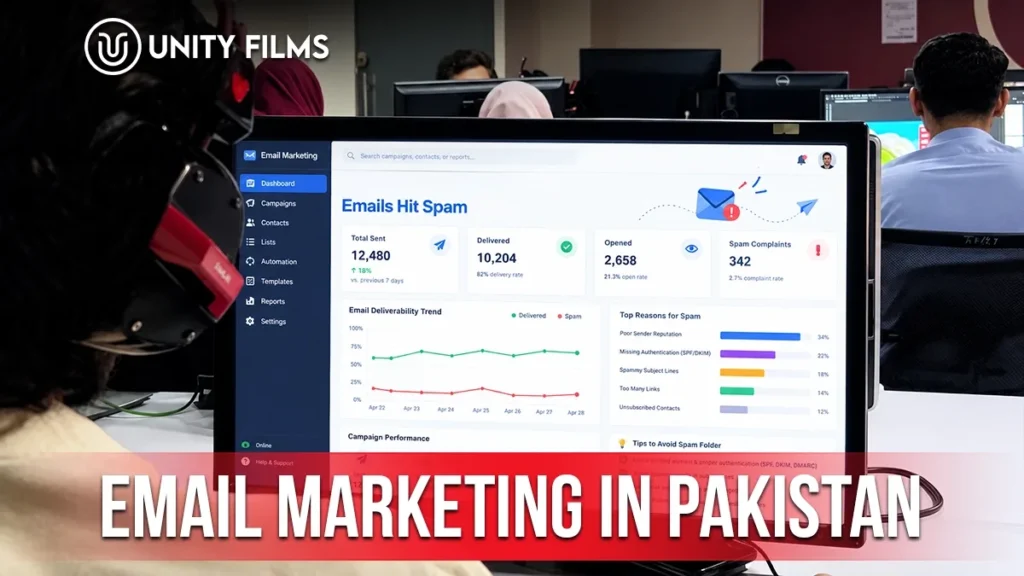
Quick answer: Email marketing in Pakistan usually fails for one fixable reason: the sending domain is not authenticated. Since February 2024 Google has required SPF, DKIM, DMARC and one-click unsubscribe from bulk senders, and keeps a spam-complaint ceiling. Without that setup, your campaign reaches the spam folder regardless of how good the writing is.
You exported 4,000 customer emails, wrote a good offer, sent it, and almost nobody opened it.
The usual conclusion is that email does not work in Pakistan. It is the wrong conclusion. The message was probably delivered to a folder nobody looks in, and that happened before anyone read a word of it.
The reason is technical, it is not expensive to fix, and almost no Pakistani business does it. That gap is the whole opportunity.
This post covers the setup that gets you into the inbox, what Google now requires, and the honest comparison against WhatsApp, which for many businesses here is the better channel.
Why Does Email Marketing in Pakistan End Up in Spam?
Because the receiving server cannot confirm you are who you say you are.
When you send a campaign from a cheap tool, or from a personal Gmail address, or from a domain with no records set up, Gmail has no way to verify the mail genuinely came from your business. An unverified sender pushing thousands of near-identical messages looks exactly like a spammer, so it is treated as one.
This is not a Pakistan-specific penalty. It applies everywhere. It just hurts more here because so few local senders have done the setup, so the ones who do stand out immediately.
Three habits make it worse in this market:
- Sending from a free address. A campaign from a gmail.com or yahoo.com address to thousands of people fails authentication alignment by design.
- Buying or scraping lists. People who never asked to hear from you mark the mail as spam, your complaint rate climbs, and the domain’s reputation drops for every future send.
- Sending rarely and in bursts. A domain that sends nothing for six months and then blasts 5,000 messages looks like a compromised account.
What Does Google Now Require From Senders?
This is the part worth knowing precisely, because it is published and specific rather than a matter of opinion.
Google’s email sender guidelines set requirements that took effect on 1 February 2024 for anyone sending more than 5,000 messages a day to Gmail addresses. Gmail is the dominant inbox for Pakistani consumers, so in practice these are the rules of the game.
| Requirement | What it means | Who sets it up |
|---|---|---|
| SPF | A DNS record naming who may send mail for your domain | Whoever manages your domain DNS |
| DKIM | A cryptographic signature on each message, 1024-bit minimum | Your email platform plus a DNS record |
| DMARC | A DNS record telling receivers what to do with failures; policy may be set to none | Your DNS |
| Alignment | Your From: domain must match the SPF or DKIM domain | Configuration, not a record |
| One-click unsubscribe | Marketing mail must support it, plus a visible unsubscribe link | Your email platform |
| Spam rate | Keep below 0.30% in Postmaster Tools; Google advises aiming under 0.10% | Your list quality |
| TLS and valid PTR records | Encrypted transmission, valid forward and reverse DNS | Your platform and host |
Two practical notes. The 5,000-a-day threshold is a line for enforcement, not a line for good practice: a domain with these records set up is treated better at any volume. And the spam-rate ceiling is the one that quietly ends campaigns, because it is driven entirely by list quality, which is the thing cheap lists destroy.
Set up Google Postmaster Tools alongside this. It is free, and it is the only place you can see your own spam complaint rate rather than guessing at it.
Should You Use Email or WhatsApp in Pakistan?
Need hands-on campaign support? Explore our email marketing services, or compare the channel with our WhatsApp marketing guide.
Honest answer: for most small businesses here, WhatsApp will outperform email, and the two are not competing for the same job anyway.
| Opened | Low, unless the list is genuinely yours | Very high |
| Good for | Detail, attachments, records, longer offers | Short, urgent, conversational |
| Cost at scale | Low per message | Rises with volume and tooling |
| Consent | Unsubscribe link required | People block fast, and that is permanent |
| Best use | Customers who bought, nurture over months | Immediate reply, order updates, quick offers |
If you are choosing where to start, our guide to WhatsApp marketing in Pakistan covers that channel properly.
Email earns its place in two situations. When the purchase takes weeks of consideration and you need to stay present without being intrusive. And when you need a record, such as invoices, bookings or documents, where WhatsApp is the wrong container.
The strongest setup is usually both, with email carrying the detail and WhatsApp carrying the urgency.
How Do You Build a List That Is Actually Yours?
Slowly, and from people who have a reason to hear from you.
Offer something specific in exchange. Not a newsletter. A price list, a size guide, a checklist, the thing your customers already ask for over WhatsApp. If the exchange is worth it, people give a real address.
Collect at the point of purchase. The single highest-quality source of addresses, and most Pakistani businesses do not ask.
Never buy a list. Beyond the complaint-rate damage, people who did not opt in do not buy. You are paying to lower your own deliverability.
Confirm new subscribers. A confirmation email that asks the person to click once removes typos and fake addresses before they sit in your list dragging down your numbers.
Clean the list every few months. Addresses that have not opened anything in a year should be removed. A smaller list that engages beats a larger one that does not, because engagement is what the receiving server measures.
If you are collecting addresses from content rather than from sales, our post on content marketing for small business in Pakistan covers what to put in front of people first. Video works for this too, and YouTube leads in Pakistan covers turning viewers into contacts.
When Email Marketing Is Not Right for You
Three situations where the effort goes elsewhere.
You have fewer than a few hundred real customers. At that size, personal messages outperform any campaign, and the setup overhead is not worth it yet. Revisit when the list is large enough that you cannot message people individually.
Your customers do not use email. If your buyers are consumers who use their phone for WhatsApp and nothing else, you can do everything right and still reach nobody. Ask five recent customers whether they check email. That answer is worth more than any national statistic.
You cannot send consistently. Email rewards a steady rhythm and punishes long gaps followed by bursts. If nobody will own a monthly send, the domain reputation you build will decay between campaigns.
A fourth, worth naming plainly. If your product is a one-off purchase that nobody repeats and that generates no referrals, there is nothing to nurture. Put the money into capturing demand instead, which our comparison of SEO vs Google Ads covers.
FAQs
Do I need my own domain for email marketing in Pakistan?
Yes, in practice. Authentication works by proving a message came from a domain you control, which you cannot do from a free gmail.com or yahoo.com address. A domain costs very little annually and it is the foundation for everything else in this post, so it is the first purchase rather than an upgrade.
Which email platform works for Pakistani businesses?
Any platform that lets you authenticate your domain and supports one-click unsubscribe will meet Google’s requirements. The real constraint here is billing: most platforms charge in dollars and Pakistani cards are sometimes declined on recurring international charges. Check that your card works on a trial before you build your whole process on a tool, and tell your bank to expect the charge.
How often should I send?
Pick a rhythm you can hold. Monthly is a reasonable starting point for most businesses, and it is better than weekly for three weeks and then nothing. Consistency matters more than frequency, both for your readers and for the sending reputation.
What is a good open rate in Pakistan?
Compare against your own previous sends rather than a published benchmark, because benchmarks average across industries, list sources and countries that have nothing to do with you. The number that matters is whether this month beat last month on the same list.
Is it legal to email customers without asking first in Pakistan?
Treat consent as required regardless of local enforcement, because the platforms enforce it even where the law is quiet. Google’s requirements include one-click unsubscribe, and spam complaints from people who never opted in will damage your deliverability long before any regulator notices.
Working With Unity Films
Email marketing is part of our digital marketing work, and the first thing we do on any new account is check whether the domain is authenticated at all, because on most Pakistani businesses it is not. That check takes minutes and it usually explains the campaign results from the previous year.
We set up the records, connect the platform, configure Postmaster Tools so you can see your own spam rate, and then build the sending rhythm around a list you own rather than one you bought.
The service sits under email marketing, and the wider channel mix under digital marketing services.
Agar aap ne pehle campaign bheja tha aur koi khas open nahi hua, to WhatsApp par domain ka naam bhej dein. Hum check kar ke bata denge ke authentication set hai ya nahi, chahe kaam hamare saath na ho.
Final Thoughts
Email marketing in Pakistan has a low bar to clear, because so few senders here have done the basic setup.
Buy the domain. Set SPF, DKIM and DMARC. Turn on one-click unsubscribe. Register Postmaster Tools and watch the spam rate. Build the list from people who gave you their address for a reason, and clean it twice a year.
That is the whole foundation, and it is cheaper than one month of ads. Everything about the writing, the offer and the timing only starts to matter once the message is actually reaching an inbox.