
Quick answer: Answer engine optimization is the practice of structuring content so AI systems like Google AI Overviews, ChatGPT and Perplexity cite you in their answers. Google published official guidance in May 2026 confirming it runs on core Search ranking systems, and naming several popular AEO tactics as unnecessary, including special schema, llms.txt files and content chunking.
There is a lot of money being made selling answer engine optimization right now.
Agencies offer AEO audits. Tools promise AI visibility scores. Consultants tell you to add llms.txt files, rewrite your pages into chunks, and bolt on schema markup so the machines can read you.
In May 2026 Google published a documentation page that addresses most of this directly, and a section of it is titled mythbusting. It is worth reading before you pay anyone for any of it.
This guide covers what Google actually said, what independent research supports, and what a business in Pakistan should do about it.
What Is Answer Engine Optimization?
AEO is the practice of making your content usable as a source inside AI-generated answers rather than only as a blue link in a results page.
The engines involved are Google AI Overviews and AI Mode, ChatGPT, Perplexity, Gemini and Microsoft Copilot. Each behaves slightly differently. Published measurements put Perplexity at around 6.6 citations per answer and Gemini around 6.1, while ChatGPT cites roughly 2.6. Fewer citations means more competition for each slot.
The reason this matters now is simple. One measurement study of over 55,000 Google queries found AI Overviews appearing on 13.7 percent of trending searches but 64.7 percent of question-form queries. Question-form queries are exactly what business blogs are built to answer.
So the pages most likely to be summarised above the results are the ones businesses spend the most effort writing.
What Did Google Actually Publish in May 2026?
This is the part most AEO articles skip, probably because it undercuts what they are selling.
Google’s guide to optimising for generative AI features states that these features are rooted in its core Search ranking and quality systems. They do not run on a separate, secret engine.
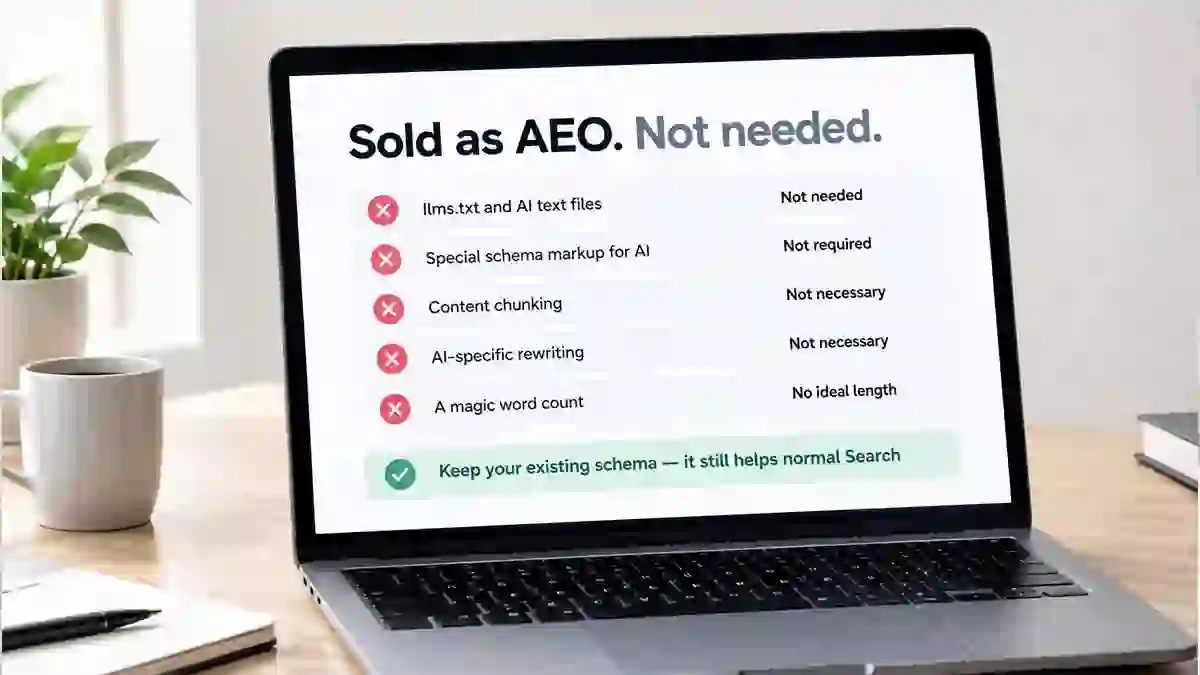
The guide includes a mythbusting section naming tactics that are not needed:
| Commonly sold tactic | What Google says |
|---|---|
| llms.txt and AI text files | Not needed. Google may crawl the file but it gets no special treatment |
| Special schema markup for AI | Not required. There is no AI-specific schema to add |
| Content chunking | Not necessary for Google Search |
| AI-specific rewriting | Not necessary |
| A magic word count or section length | Google explicitly rejects an ideal length |
One nuance that gets misreported in both directions. Google says structured data is not required for AI features, and also says keep using it, because it keeps you eligible for rich results in normal Search. “Not required for AI” does not mean “remove your schema”.
Worth knowing alongside that: Google deprecated FAQ rich results on 7 May 2026, so FAQPage markup no longer produces a dropdown in search results. The markup causes no harm and still helps machines parse the page, but it is not an AI visibility lever and anyone selling it as one is behind.
Search Engine Journal summarised the guide bluntly in its headline on the release: AEO and GEO are still SEO.
Which AEO Tactics Does the Evidence Actually Support?
Not nothing. Three things have measurement behind them.
Evidence inside the content. The academic paper that introduced generative engine optimisation tested content interventions and found that adding quotations from credible sources raised a source’s share of the AI answer by roughly 41 percent, statistics by about 31 percent, and citations by about 28 percent. Keyword stuffing performed poorly.
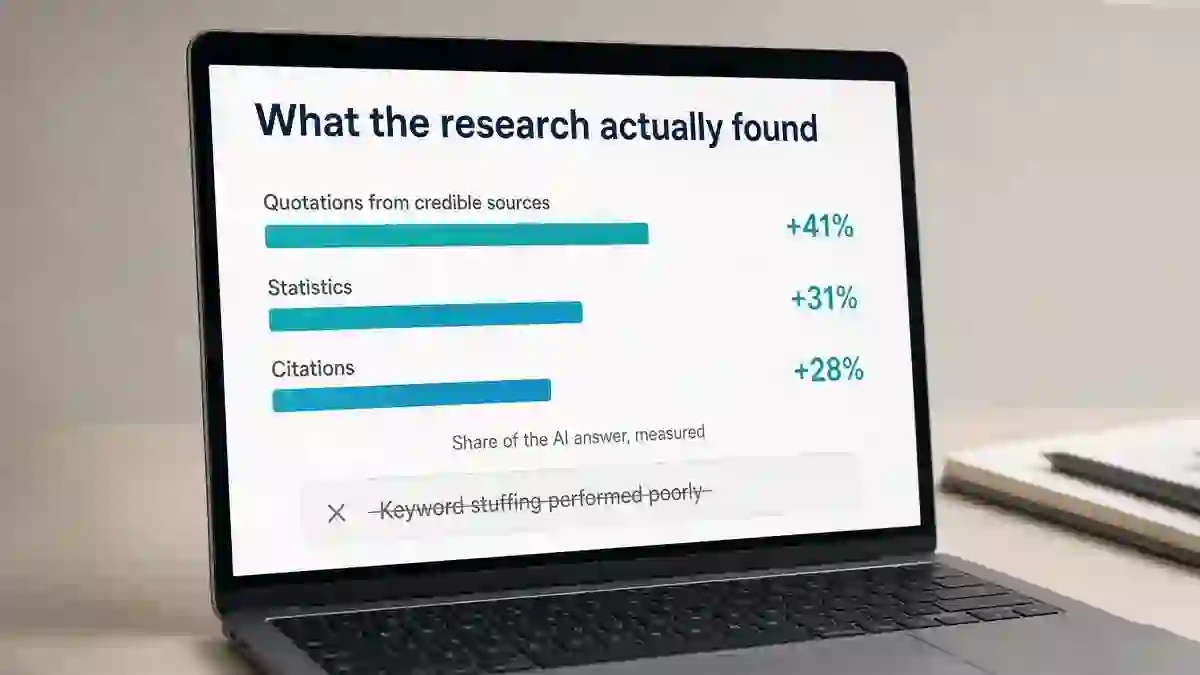
That is the single most useful finding in this field, and it is not a technical trick. It says: cite your sources, use real numbers, quote people who know things.
Answers placed early on the page. CXL’s analysis of 100 Google AI Overview citations found that 55 percent came from the first 30 percent of the source page. A clear answer near the top is more likely to be the part that gets lifted.
Being findable in normal search. Google’s AI features documentation states a page must be indexed and eligible to appear with a snippet before it can be shown in AI Overviews or AI Mode. If you do not rank, you are not in the pool.
Three unglamorous things. No markup, no files, no chunking.
Why Is the Most-Quoted AEO Statistic Misleading?
You will see this everywhere: 99 percent of URLs cited in Google AI Overviews come from pages already ranking in the organic top ten.
Treat it carefully. Analysts have pointed out that the figure counts queries where there is any overlap at all between the citations and the top ten, not the share of individual citations that come from top-ten pages. Those are very different claims.
Other measurements disagree sharply. One analysis found only 12 percent of URLs cited by LLMs generally appeared in Google’s top ten, with AI Overviews being the exception at around 76 percent.
The honest reading is this. For Google AI Overviews, ranking is close to a prerequisite. For ChatGPT and Perplexity, which draw on different indexes and sources, the relationship is much looser. A page can be cited by one and invisible to the other.
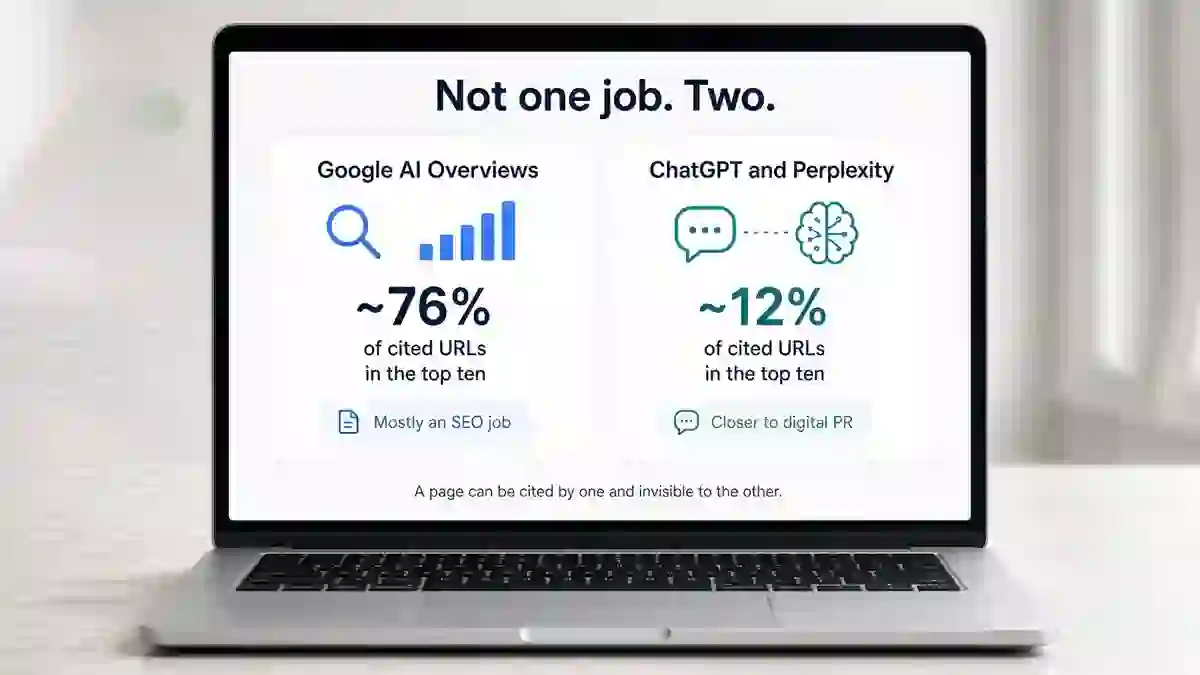
Which means AEO is not one job. Winning AI Overviews is mostly an SEO job. Winning ChatGPT citations depends more on being mentioned across many sources, which is closer to digital PR than to on-page work.
How Do You Measure Any of This?
Until recently you could not, which is part of why the field filled up with unverifiable claims.
Search Console now reports it. Google introduced generative AI performance reporting in Search Console in June 2026, so AI feature impressions are visible rather than guessed at.
Ask the engines directly. Search your business name and your main service in ChatGPT, Perplexity and Google AI Mode. Note who gets cited instead of you. This takes ten minutes and tells you more than most paid tools.
Track mentions, not just links. An AI answer that recommends your business without linking you still produces enquiries. Those arrive as direct traffic or a WhatsApp message, and no analytics tool attributes them.
Expect a slow curve. This is SEO work, so the timeline is the same: ads produce results in the first week, a Google Business Profile in four to eight weeks, and anything content-driven in three to six months.
What Does This Mean for a Business in Pakistan?
Three practical things, and the first one is the biggest opportunity.
Competition for AI citations here is almost nonexistent. Very few Pakistani businesses publish content that answers buying questions with sourced evidence. The bar to become the cited source for a local category is far lower than in Western markets, exactly as it is for ordinary rankings.
Your Google Business Profile does heavy lifting. For local and shopping queries, Google draws on your verified Business Profile rather than your schema. Completing it properly through GMB optimization does more for local AI visibility than any markup you could add.
Video is a real citation source. YouTube appears in roughly a quarter of Google AI Overviews, making it the largest single video source in AI answers. For a business already producing video, that is a channel into AI results that most competitors are not using.
And the usual Pakistani reality applies underneath all of it. Whatever brings someone to you, the conversation finishes on WhatsApp. Test the page an AI answer would send them to on a mid-range Android on mobile data, because that is the device almost every visitor will be holding, and no amount of citation visibility survives a page that will not load.
When AEO Is Not Your Priority
Plainly, because this is the most over-sold topic in marketing right now.
You do not rank for anything yet. For Google AI features, indexing and ranking come first. AEO work on a site with no visibility is optimising for a stage you have not reached.
Your Google listing is empty. For a local business that is where AI pulls your details from. Fix it before anything else.
Nobody is searching your category in question form. AEO matters most where people ask questions. If your customers search a product name and buy, this is not where your money should go.
You are being sold an AEO audit as a separate product. Google’s own guidance calls these features still SEO. An agency selling AEO as a distinct service at a distinct price should be able to explain what it includes that good SEO does not. Our guide on how to choose a digital marketing agency covers asking that kind of question properly.
FAQs
Is AEO different from SEO?
Partly. For Google AI Overviews, Google states the features run on its core ranking systems, so the work is largely the same. For ChatGPT and Perplexity, which use different sources, being mentioned widely across the web matters more than your own page optimization. So it is SEO plus something closer to PR.
Do I need to add llms.txt to my website?
No. Google’s May 2026 guidance states explicitly that you do not need machine-readable files, AI text files or special markup. Google may crawl such a file, but it receives no special treatment.
Should I remove my FAQ schema now that rich results are gone?
No. Google confirms unused structured data causes no problems, and schema still helps machines understand your page. Just stop treating it as an AI visibility tactic, because it is not one.
How do I know if AI is recommending my business?
Ask it. Search your category in ChatGPT, Perplexity and Google AI Mode and see who gets named. Then check Search Console’s generative AI performance report for the Google side. Between them you get a usable picture at no cost.
Working With Unity Films
Our SEO service does not sell AEO as a separate line item, because Google’s own documentation says these features run on the same ranking systems as the rest of Search.
What we do differently is write content the way the evidence says works: a clear answer early, real numbers attributed to named sources, and sources linked rather than claimed. That is what the research on AI citations keeps pointing at, and it happens to produce better content for humans too.
We also shoot and edit video in-house, which matters more than it used to now that YouTube is one of the largest single sources AI Overviews draw from.
If someone has quoted you for an AEO package and you want a second opinion on what is actually in it, send it to us.
Final Thoughts
Answer engine optimization is real, and most of what is sold under that name is not.
Google has published the answer. These features run on core Search systems, no special file or markup is required, and the fundamentals still decide who gets cited. The independent research adds three things worth doing: answer early, use real evidence, and cite your sources.
For a business in Pakistan the opportunity is larger than in most markets, because almost nobody here is publishing the kind of sourced, question-answering content these systems prefer. That gap will not stay open forever.