
Every new creator does the same thing after uploading their first video. They refresh their subscriber count, google the monetization requirements, and quietly panic at the phrase “4,000 watch hours.” It’s a deceptively large number when your channel has 47 total views.
The honest reality of YouTube watch hours in 2026 is that only about 3% of channels ever cross the threshold, but the ones that do usually didn’t do anything magical. They understood how the metric actually works, focused on watch time per video instead of view count, and stayed consistent for 6-12 months while most competitors quit.
Across channels we’ve worked on, the difference between channels that hit 4,000 watch hours in 6 months and channels that stall at 3,800 hours for a year usually comes down to two decisions: video length and viewer retention. This guide walks through what YouTube watch hours actually are, the exact monetization thresholds in 2026, how to calculate your realistic timeline, and the 8 proven strategies that move the number without gaming the system.
What Are YouTube Watch Hours?
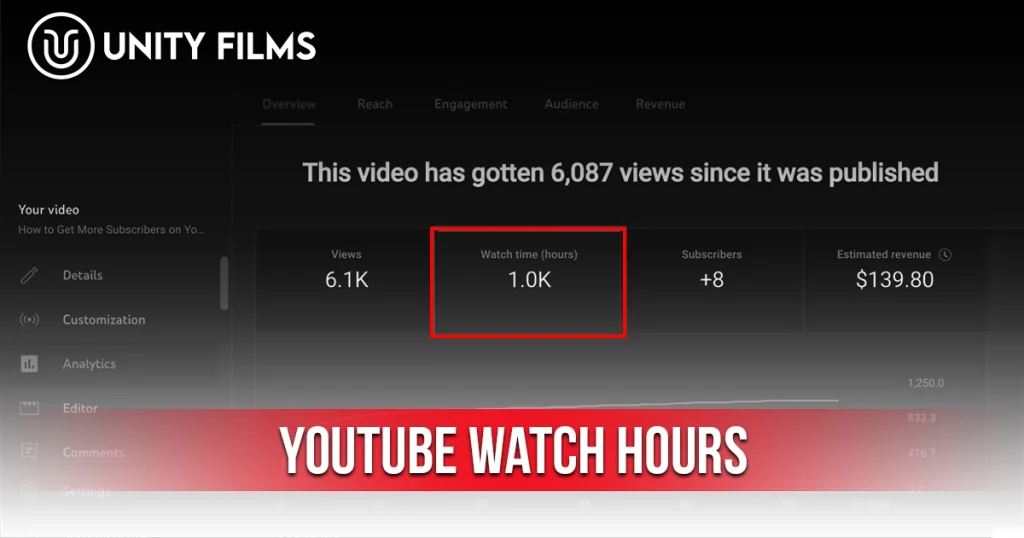
YouTube watch hours are the total number of hours viewers have spent watching your public long-form videos over a rolling 12-month window. You can see the current total in YouTube Studio under Analytics → Overview, or under Earn if you’re actively tracking monetization progress.
The critical word is rolling. Watch hours don’t accumulate forever. YouTube tracks the past 365 days, and hours from videos watched more than a year ago fall off the total. This means channels that stop uploading eventually lose eligibility as their old watch hours expire.
Not all watch time counts. What does and doesn’t:
Counts toward YouTube watch hours:
- Public long-form videos (any length)
- Live streams set to public
- Premieres (both live premiere phase and later public views)
Doesn’t count:
- YouTube Shorts (tracked separately for a different monetization path)
- Private videos
- Unlisted videos
- Deleted videos (watch hours removed instantly)
- Ad time, end screen time, description reading time
According to YouTube’s official Partner Program page, the 4,000 watch hour threshold specifically refers to valid public watch hours, which excludes anything YouTube deems inauthentic (bots, view farms, incentivized watches). With over 500 hours of content uploaded to YouTube every minute, YouTube has tightened enforcement of this rule specifically to protect the integrity of monetization thresholds.
YouTube Watch Hours: The Exact 2026 Monetization Requirements
There are actually two tiers of monetization in 2026, and understanding both matters because most creators only know about the second one.
| Tier | Subscribers | Watch Hours OR Shorts Views | What It Unlocks |
|---|---|---|---|
| Tier 1 (Fan Funding) | 500 | 3,000 hours in 12 months OR 3M Shorts views in 90 days | Super Chat, Super Thanks, memberships, Shopping |
| Tier 2 (Full YPP) | 1,000 | 4,000 hours in 12 months OR 10M Shorts views in 90 days | Ad revenue on long-form, YouTube Premium share, Shorts ad revenue |
Tier 1 is the earlier, easier bar. It unlocks fan-based income streams like YouTube Super Chat and channel memberships, which can start generating real revenue before you hit the full watch hour threshold. Most creators skip this step entirely and wait for Tier 2, missing months of potential income in between.
Tier 2 is the “full monetization” everyone talks about. It adds the AdSense revenue on both long-form and Shorts, plus YouTube Premium subscription revenue share. Ad revenue splits at 55% for creators on long-form and 45% for creators on Shorts.
Additional requirements for both tiers (often skipped in guides):
- Channel account must be at least 30 days old
- Linked AdSense account
- Two-factor authentication enabled on your Google account
- No active Community Guidelines strikes
- Residency in one of the 120+ YPP-eligible countries
- Clean policy record for reused content, misleading metadata, and the recently tightened Inauthentic Content policy
How Many Views Equals 4,000 Watch Hours?
This is where creators usually panic. 4,000 hours sounds impossible when you’re pulling 100 daily views. The math is more forgiving than it looks, especially with longer videos and strong retention.
The formula is simple:
Watch Hours = (Total Views × Average View Duration in minutes) ÷ 60Here’s what that looks like in practice at different video lengths and retention rates:
| Video Length | Avg View Duration | Views Needed for 4,000 Hours |
|---|---|---|
| 3 minutes | 1.5 minutes | 160,000 views |
| 8 minutes | 4 minutes | 60,000 views |
| 15 minutes | 7 minutes | 34,000 views |
| 20 minutes | 10 minutes | 24,000 views |
| 30 minutes | 15 minutes | 16,000 views |
The pattern jumps out immediately. A creator posting 15-minute tutorials with 70% average retention reaches monetization roughly 5x faster than a creator posting 3-minute videos with 50% retention. Same audience, same effort, wildly different timelines. Longer videos with strong retention aren’t just nice. They’re mathematically faster to monetization.
Our full breakdown of YouTube views per month covers how monthly view targets translate directly into watch hour milestones.
How Long Does It Take to Get 4,000 YouTube Watch Hours?
Most channels reach 4,000 watch hours within 6 to 12 months of consistent uploading. Channels combining evergreen long-form content with regular live streams tend to land at the lower end. Channels relying on a single content type or sporadic uploads trend toward the upper end, or longer.
You can estimate your own timeline with this formula:
Monthly Watch Hours = (Average Monthly Views × Average View Duration in minutes) ÷ 60Then divide 4,000 by that number to see roughly how many months you’re away at your current pace. If your current monthly watch hours are 400, you’re 10 months out. If they’re 800, you’re 5 months out. Simple math, honest answer.
Honestly, the exact timeline varies more than most guides admit. Niche, upload frequency, retention and library depth all shift the calculation significantly. What’s consistent is that channels focused on watch time per video reach 4,000 hours faster than channels focused purely on views. Retention beats reach almost every time.
8 Proven Strategies to Increase YouTube Watch Hours
These are the moves that actually move the number. None of them are gimmicks, and none of them game the system.
1. Make Longer Videos (When the Content Justifies It)
The single fastest lever. A 10-minute video with 50% retention produces the same watch time as five 4-minute videos with 25% retention but requires far less production work. Longer videos also give the algorithm more surface area to test.
This doesn’t mean stretching every video artificially. It means picking topics that genuinely deserve 10-15 minute treatments and delivering the full value. According to StudioBinder’s creator research, structured video production with planned hooks, segments, and CTAs significantly improves both retention and watch time compared to unstructured uploads. Our guide on how to write a YouTube script covers the framework that keeps longer videos engaging instead of bloated.
2. Fix Your First 30 Seconds
The first 30 seconds are where retention lives or dies. If viewers drop off in the first 15 seconds, the rest of your video length is meaningless, because no watch hours accumulate.
Cut the logo animation, the “welcome back to my channel,” and any preamble. State the value upfront and get to the payoff quickly. Channels that fix their intros almost always see immediate watch hour lifts within 30 days.
3. Build Playlists for Binge Sessions
A viewer who watches three of your videos in one session generates roughly triple the watch hours of a viewer who watches one video and leaves. Playlists engineer this by auto-suggesting your next video after the current one ends.
Build playlists around viewer journeys, not just topics. “How to fix your dishwasher” should sit next to “Best dishwasher parts” and related content. Same audience, sequential value, compounding watch hours.
4. Start a Consistent Live Stream Schedule
Live streams are one of the most underused watch hour multipliers on YouTube. Every minute a public live viewer watches counts the same as upload watch time, but a single stream can rack up dozens of hours in one session with a small audience.
A 2-hour weekly stream with 15 concurrent viewers produces 30 watch hours per stream, or 120+ hours per month. Combined with your regular upload schedule, this can dramatically compress your timeline to 4,000 hours.
5. Add Cards at Retention Drop-Off Points
Open YouTube Studio, find each video’s retention graph, and locate the biggest drop-off moment. Add a card at that timestamp linking to a related video. Viewers who were about to leave now have a one-click path to more of your content, extending session length and watch hours.
This single Studio adjustment pays compounding returns. Most creators never do it because it feels tedious, which is exactly why it works.
6. Publish Premieres Instead of Regular Uploads
Premieres are hybrid events that debut as scheduled live streams (banking concurrent-viewer watch hours during the launch) and then convert to standard public videos that continue accumulating hours. You get both types of watch time from a single production.
Not every video needs to be a Premiere, but for anchor content and important releases, they’re a legitimate way to double-dip on watch time without any additional work.
7. Layer Shorts as a Discovery Funnel
Shorts don’t count toward the 4,000 watch hour threshold directly, but well-crafted Shorts drive new viewers to your long-form content, which does count. Aim for 2-3 Shorts per week that tease or summarize specific long-form videos, with clear links in the description.
This funnel design is what makes Shorts genuinely useful for watch hour growth. Random Shorts unrelated to your main content pull audiences that never convert to long-form watchers.
8. Audit and Improve Weak Old Videos
Old videos with strong retention but weak CTR are usually one thumbnail or title update away from a second wave of impressions. That second wave adds directly to your watch hours without any new production work.
Sort your videos in YouTube Studio by impressions, filter to anything published 6+ months ago with retention above 40% and CTR under 4%, and rework the packaging on your worst-performing thumbnails. Combine with a full YouTube SEO checklist audit for maximum compounding effect.
Common YouTube Watch Hour Mistakes
A few errors quietly stall watch hour growth. Watch for these:
- Chasing views instead of watch time. Two 100,000-view videos with 30 seconds retention beat one 20,000-view video with 8 minutes retention on the vanity dashboard, but the second produces 10x more watch hours.
- Deleting weak videos. Deleting removes watch hours immediately. A video with 200 watch hours you’re embarrassed about is still 200 hours closer to monetization.
- Making Shorts your primary strategy for long-form monetization. Shorts and long-form are different paths. Pick one and commit.
- Ignoring the lower tier (500 subs + 3,000 hours). Fan funding features unlock real revenue months before full monetization does.
- Watching your own videos on repeat. YouTube’s system filters out inauthentic watch time.
- Uploading inconsistently. Long gaps mean fewer distribution opportunities.
The most fixable mistake is short-form-only content strategy. A 60-second video maxes out at 60 seconds of possible watch time per view. A 15-minute video with 60% retention delivers 9 minutes per view, a 9x difference in watch hour velocity from the exact same viewer.
The Contrarian Truth About YouTube Watch Hours
Most monetization guides frame 4,000 watch hours as the goal. It isn’t.
Watch hours are a side effect of great content, not a target to optimize directly. The moment you start chasing watch hours specifically, by padding videos, adding filler and dragging out intros, retention drops and the whole loop breaks. The algorithm reads padded videos as low-value and slows distribution, which reduces watch hours faster than the padding could ever add.
The honest hierarchy of what produces watch hours:
- 50% comes from average view duration on your videos. For most long-form content that sits between 30% and 50%, and anything above 50% is strong.
- 25% comes from total impressions and CTR. More views multiply your retention gains.
- 15% comes from session-based watching: playlists, cards, and end screens that extend one viewer’s session.
- 10% comes from live streaming and Premieres: high-multiplier watch time in single events.
Probably more important than any specific tactic is picking niches that reward longer content. Our breakdown of best faceless YouTube niches for 2026 covers the categories where 10-20 minute videos genuinely deliver value.
Most beginners obsess over 4,000 hours as a finish line. Smart creators obsess over retention as a habit.
Frequently Asked Questions
How many YouTube watch hours do I need for monetization?
You need 4,000 valid public watch hours in the past 12 months plus 1,000 subscribers for the full YouTube Partner Program (Tier 2). An earlier tier at 500 subscribers plus 3,000 watch hours unlocks fan-funding features like Super Chat and memberships.
Do YouTube Shorts count toward the 4,000 watch hours?
No. Watch time from Shorts is tracked separately and doesn’t apply to the 4,000 hour requirement. The Shorts monetization path requires 10 million valid public Shorts views in the past 90 days plus 1,000 subscribers for full YPP access.
How long does it take to get 4,000 YouTube watch hours?
Most channels reach 4,000 watch hours within 6 to 12 months of consistent uploading. Channels using long-form content plus regular live streams tend to land at the lower end. Channels relying on short videos or sporadic uploads land at the upper end or longer.
Does watching my own YouTube videos count as watch hours?
No. YouTube’s system filters out inauthentic watch time, including views from your own account, view farms, and incentivized watches. Only genuine public viewership counts toward the 4,000 hour threshold.
What is the fastest way to get 4,000 watch hours on YouTube?
Focus on longer videos with strong retention, run consistent live streams (which count toward watch hours), and build playlists that create binge sessions. A 24/7 curated live stream with steady concurrent viewers can accelerate the timeline dramatically, though YouTube’s Inauthentic Content policy requires genuine interactive value, not looped clips.
Also Read: How to Increase Your YouTube Watch Time to Monetize Your Channel?
Final Thoughts
Reaching 4,000 YouTube watch hours isn’t about gaming a metric. It’s about building a channel viewers genuinely want to spend time with, then letting the math take care of itself.
The shift is psychological. Stop checking your watch hour count daily like it’s a slot machine. Start tracking average view duration and retention on each new upload. Those are the leading indicators. Watch hours are the lagging result.
So pick your next upload, extend it to at least 8-10 minutes if the content justifies it, tighten the first 30 seconds ruthlessly, and add a card at the biggest retention drop-off point. Track the watch hour lift over 30 days. Or if you’d rather skip the grind and have a team handle production, retention optimization, and channel growth from scratch to monetization, Unity Films YouTube Management Services specializes in taking channels from zero to full YPP eligibility.