
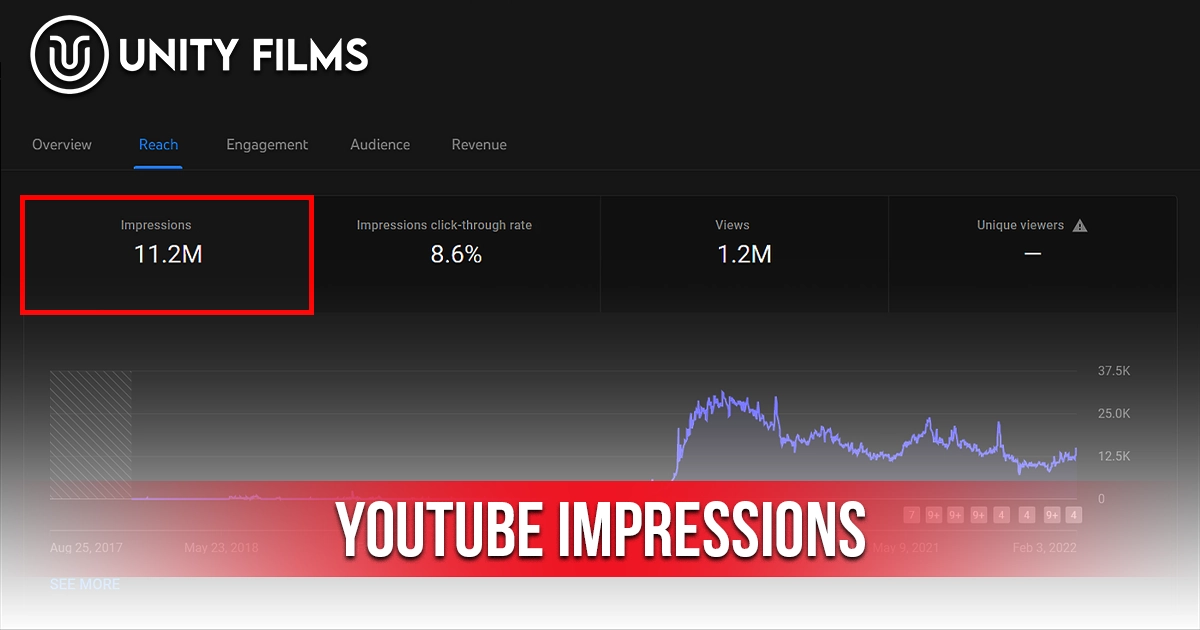
You open YouTube Studio, glance at your latest video, and see the dreaded line: low impressions. The algorithm just isn’t showing your video to people. So what now?
Understanding YouTube impressions is the missing piece for most creators. They obsess over views, subscribers, and watch time, but impressions are the metric that quietly decides whether any of those other numbers ever grow.
Across channels we’ve worked on, the pattern is almost always the same. A video stalls not because the content is weak, but because impressions never get distributed widely enough for the algorithm to gather real data. Once that loop breaks, the whole growth engine stops.
This guide explains what YouTube impressions actually are, how the algorithm decides who sees your video, why your impressions might suddenly drop, and the seven proven ways to get more of them in 2026. By the end, you’ll stop staring at YouTube Studio confused and start moving the only number that controls everything downstream.
What Are YouTube Impressions?
A YouTube impression is logged when your video’s thumbnail is shown to someone on the platform. That includes the home feed, search results, suggested videos, the subscription feed, and your channel page. If your thumbnail appears in front of a viewer, that’s one impression.
But there’s an important detail most creators missed. In February 2026, YouTube quietly changed how impressions are counted. Previously, an impression registered when your thumbnail flashed on screen for any moment at all. Now, a thumbnail has to be visible for at least 1.5 seconds to count. The result is that many creators saw their impression numbers drop overnight, even though nothing about their content had changed.
Honestly, this change confused a lot of people, and the data on whether it affected smaller channels more than larger ones is still messy. What’s clear is the new number is more accurate, not worse. You’re now seeing impressions that actually had a real chance of being noticed.
| Term | What It Means |
|---|---|
| Impression | Your thumbnail shown for at least 1.5 seconds |
| Click-through rate (CTR) | Percentage of impressions that turn into clicks |
| View | A click that becomes an actual viewing session |
| Watch time | Total minutes watched across all viewers |
These four numbers happen in order. Impressions come first, and everything else follows. Without impressions, the rest of the funnel never even starts.
How YouTube Decides Who Sees Your Video
The algorithm is not a black box, even though it often feels like one. YouTube has spoken openly about the signals it uses, and the system follows a fairly logical pattern when deciding distribution.
When you upload, YouTube tests your video on a small initial audience. That sample is usually your subscribers, people who watched similar videos recently, or viewers in the same niche. The platform watches what happens next:
- Do people click the thumbnail?
- Do they keep watching?
- Do they engage (like, comment, share, save)?
- Do they continue watching YouTube after your video ends?
If those signals look strong, the algorithm expands distribution. More impressions, broader audience, eventually the suggested videos shelf and the home feed. If the signals look weak, distribution slows or stops, sometimes within hours of upload.
This is why the first 24 to 48 hours matter so much. According to creator data analyzed across multiple 2026 studies, roughly 70% of a video’s lifetime performance is decided in that initial testing window. Get strong signals fast, and the algorithm keeps feeding you impressions. Get weak signals, and the door closes quickly.
Why Your YouTube Impressions Might Be Low
If your impressions just dropped, there are usually four explanations. Walk through them honestly before assuming the algorithm is “broken.”
- Weak click-through rate on past videos. The algorithm cuts impressions when your channel’s recent videos haven’t earned clicks.
- Low retention on past videos. Clicks without retention are punished harder than no clicks at all. YouTube calls this Quality CTR.
- Inconsistent upload schedule. Long gaps between uploads mean less recent engagement data for the algorithm to work with.
- Topic drift. When you suddenly cover a topic outside your usual niche, YouTube isn’t sure who to show it to, so initial impressions stay low.
There’s a fifth explanation that’s harder to admit: sometimes the video just isn’t packaged well. The thumbnail doesn’t stop the scroll, or the title doesn’t promise something specific enough to click. Probably more important than fixing your “low impressions” is fixing the upstream cause that made the algorithm pull back in the first place.
How to Get More YouTube Impressions in 2026
These seven moves directly influence the signals that drive impression growth. None of them are magic. All of them compound.
1. Raise Your CTR on Existing Videos
This is the most direct lever. According to YouTube’s own Help documentation, half of all channels and videos sit between a 2% and 10% impressions click-through rate, with newer or smaller channels often seeing a wider range. If you’re under 4% on a new upload, your packaging needs work, not your content.
Find your highest-impression, lowest-CTR videos in YouTube Studio under Analytics → Reach. Those are the leaky buckets. Swap the thumbnails first, then test new titles. The boost in CTR on already-distributed videos sends a positive signal that lifts impressions on future uploads too.
2. Improve Retention, Not Just Clicks
A high CTR means nothing if viewers leave within 10 seconds. The algorithm pairs CTR with retention to evaluate satisfaction. A 10% CTR with 20% average view duration loses to a 5% CTR with 60% retention almost every time. Strengthen your hook in the first 15 seconds, and the impression flow follows.
3. Publish Consistently
Each upload is a fresh chance for the algorithm to gather data. Channels that publish weekly build momentum because each new video reinforces the channel’s audience profile. Long silences mean stale data, and stale data means cautious distribution. We’ve seen channels recover impressions just by returning to a steady weekly cadence after months off.
4. Build Session Time With Playlists and End Screens
When a viewer watches several of your videos in one sitting, YouTube reads that as one of the strongest possible signals. Playlists and end screens are the tools that turn one viewer into a binge session. If you haven’t set them up yet, our guide to the YouTube end screen strategy walks through exactly how to do it in under two minutes per video.
5. Match Your Niche With Disciplined Topic Choice
Topic drift kills impressions faster than anything else. If your channel has trained the algorithm to associate you with personal finance, a sudden travel vlog will struggle in the testing window. Stay close to what your audience already expects, and your impression baseline holds steady. If you’re rethinking your niche entirely, check our breakdown of the best faceless YouTube niches for 2026 before pivoting blindly.
6. Optimize Every Upload With a Proper Checklist
Most creators wing the metadata side, which leaks impressions on a thousand small details. A complete YouTube SEO checklist covering titles, descriptions, tags, captions, and chapters compounds across every video on your channel. The 18-step version exists specifically because skipping even a few steps reduces how confidently YouTube can match you with the right viewers.
7. Drive Quality External Traffic, Not Random Clicks
External traffic doesn’t directly increase YouTube’s algorithmic distribution, but it indirectly helps if the external clickers actually watch. Sending five friends who don’t care about your topic is worse than sending zero, because their poor retention drags your signal down. Better to share in genuinely interested communities than to spam links anywhere.
YouTube Impression Benchmarks by Channel Size
What counts as “good” impressions varies dramatically by channel size, niche, and traffic source. The same number that’s normal for a small channel is alarming for a larger one. Here’s a realistic frame:
| Channel Size | Typical New-Video CTR | Healthy Impressions/Day |
|---|---|---|
| Under 1,000 subscribers | 6-10% | 500-2,000 |
| 1,000-10,000 subscribers | 5-8% | 2,000-10,000 |
| 10,000-100,000 subscribers | 4-6% | 10,000-50,000 |
| 100,000+ subscribers | 3-5% | 50,000+ |
CTR naturally declines as channels grow because the algorithm shows your content to broader, less-targeted audiences. A drop from 8% to 4% over a year of growth isn’t a problem. It’s a sign your reach expanded beyond your most loyal viewers. The signal to watch is speed of decline, not the number itself.
The Contrarian Truth About YouTube Impressions
This is where most advice gets it wrong. Creators chase impressions as if they’re the goal. They’re not. They’re the input.
The honest hierarchy:
- Impressions are downstream of satisfaction. You don’t earn more impressions by demanding them. You earn them by satisfying the viewers you already get.
- Quality CTR matters more than CTR alone. A 3% CTR with 70% retention beats a 9% CTR with 25% retention, every time.
- Returning viewers are 5-10x more valuable to the algorithm than new ones. Building a returning audience is the slowest impression-growth lever and the most permanent one.
Most beginners chase the impressions number. Smart creators chase viewer satisfaction and let impressions follow. The first approach is exhausting and rarely works. The second compounds quietly until the algorithm trusts your channel enough to hand you the distribution you used to beg for.
Frequently Asked Questions
What is a good number of YouTube impressions?
There’s no single “good” number. A small channel might see a few hundred impressions per day, while a larger one sees millions. What matters more is the ratio. Healthy impressions paired with a 4-10% click-through rate and strong retention are far better signals than raw impression volume alone.
Why did my YouTube impressions suddenly drop?
The most common causes are a recent dip in CTR or retention, a long gap between uploads, or a video that drifted off your usual niche. YouTube also changed how impressions are counted in February 2026, requiring 1.5 seconds of visibility, which lowered numbers for many channels overnight without anything else changing.
Do YouTube impressions count if no one clicks?
Yes. An impression is registered the moment your thumbnail is visible to someone for at least 1.5 seconds, regardless of whether they click. The impression count tells you how often YouTube put your video in front of viewers. CTR tells you how compelling that thumbnail and title combination actually was.
How long does it take to increase impressions?
Once you improve your CTR and retention, you usually see impression growth within 1 to 3 weeks. The algorithm tests your updated signals on small audiences first, then expands distribution if those signals stay strong. Major impression growth often comes in waves rather than steady increases.
Can external traffic increase YouTube impressions?
Indirectly, yes. External traffic itself isn’t counted as an algorithmic impression, but if external viewers actually watch and engage, that boosts your overall satisfaction signals. The catch is that low-quality external traffic that doesn’t retain can actually hurt distribution by lowering your average watch time.
Also Read: YouTube SEO Checklist 2026: The 18-Point Guide to Rank Videos and Get More Views
Final Thoughts
YouTube impressions aren’t something you chase. They’re something you earn by giving viewers a reason to click, stay, and come back. The creators who panic about low impressions usually have a satisfaction problem, not a distribution problem.
The real shift is psychological. Stop thinking of impressions as the metric you optimize and start thinking of them as the report card the algorithm hands you. Every drop is feedback. Every spike is confirmation. Your job is to deliver content worth showing.
Pick one of the seven moves above and apply it to your next upload, starting today. Sharpen the thumbnail, tighten the hook, or fix your worst-performing existing video. Or if you’d rather have a team handle channel growth, optimization, and impression strategy end to end, Unity Films YouTube Management Services covers the full stack so you can focus on creating.